What if HR's job stopped being cost containment and started being revenue contribution?
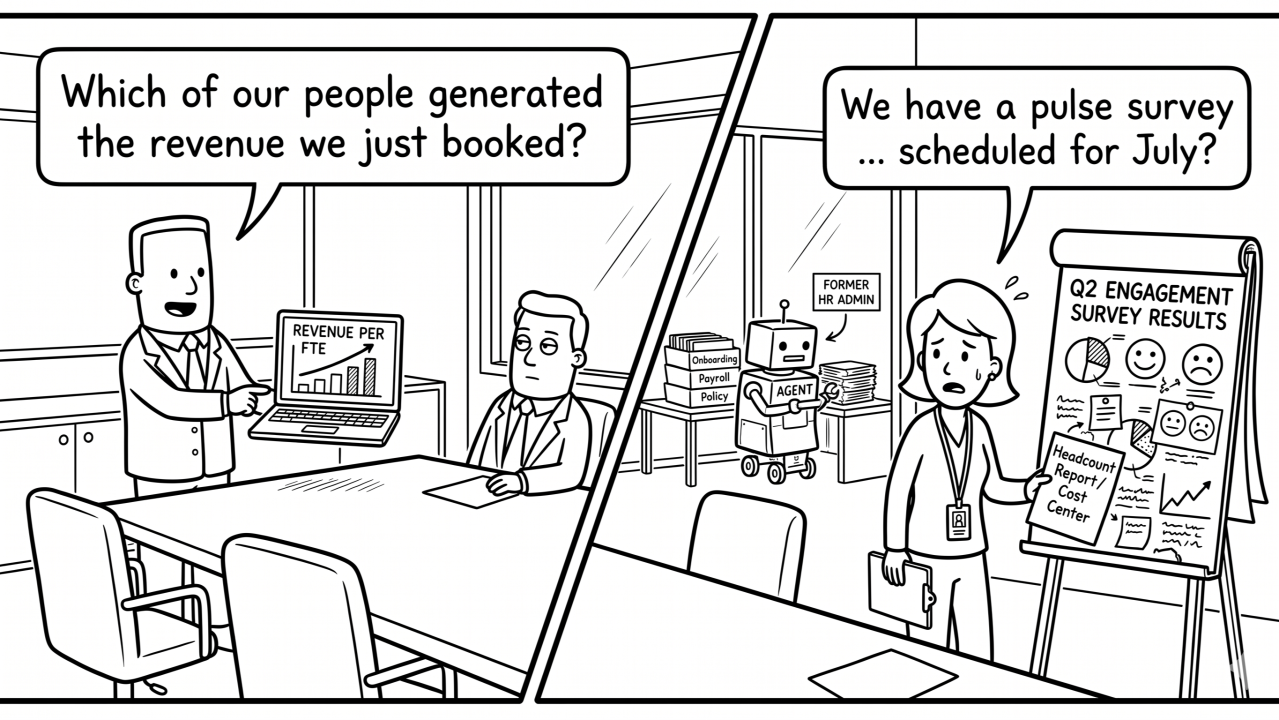
Imagine a CEO asks two simple questions at the start of the next budget cycle.
"Which of our people generate the revenue we just booked?" And, "Which HR investments drove how much of it?"
Most HR functions cannot answer either question. Not because the data is missing, but because the function has never been designed to ask them. HR was built to manage people at scale, enforce fairness, and keep the cost line predictable. Revenue was somebody else's job.
That design worked for thirty years. It stopped working around the time Finance started using revenue-per-employee as the primary productivity benchmark, and CEOs started asking AI what it could automate before asking HR what it should preserve.
The honest question now is not whether HR modernizes. It is whether HR continues to own the people agenda at all, or whether a quieter version of the function gets assembled around it by RevOps, Finance, and IT - while HR keeps running surveys.
The function was built for a world that no longer exists
Dave Ulrich's 1997 operating model made four assumptions that the business accepted as obvious at the time: labor is roughly homogeneous and substitutable, admin work cannot be automated at scale, the CFO measures HR on cost containment, and workforce data is reporting rather than analytics.
Each of those four has now broken.
Labor is not homogeneous. A customer success manager on €55k at a SaaS company can be more pivotal to revenue than a €250k middle manager in a back-office function. Admin work is being automated right now, at pace. Gartner reports AI adoption in HR climbing from 19% in 2023 to 61% in 2025, and AIHR's March 2026 research puts agentic systems at 88% of administrative workflows and over 60% of functional HR work. The CFO no longer accepts cost-per-hire as the headline metric; revenue-per-FTE and human capital ROI have taken its place. And workforce data is no longer a weekly PDF - it is the feedstock for decisions about capacity, pricing, automation, and where to grow.
When the four assumptions break at once, the operating model does not get optimized. It gets replaced. McKinsey's 2022 survey of HR operating models found 48% of HR leaders still identifying with "Ulrich+" and 47% with "EX-driven" variants. Only 6% picked "machine-powered." That 94% is not a majority. It is a lagging indicator.
The split is already happening
Look at Netflix, Shopify, and Stripe. Three different businesses, three different origins, one common pattern: HR has been quietly disassembled and reassembled around revenue.
Netflix replaced the CHRO title with a Chief Talent Officer sitting inside the commercial leadership team - Sergio Ezama's role sits closer to the CEO's revenue conversation than to the classic people-function perimeter. Patty McCord's 2014 HBR piece, "How Netflix Reinvented HR," described the underlying logic a decade before most of the market was ready to read it: pay market value for the roles that move the business, stop spending equal time on every role just because fairness rhetoric says you should.
Shopify and Stripe run versions of the same idea. Smaller HR headcounts. Tighter loops between talent decisions and commercial outcomes. No pretense that a shared-services clerk and a senior growth engineer need the same developmental attention.
None of these companies call what they have done "HR transformation." They call it running the business. That is the tell.
In the rest of the Fortune 500, the same split is happening under sanitized names. "Revenue Enablement." "Talent Strategy." "Business Partner of the Future." Meanwhile the HR shared services function gets rebranded as "People Ops 2.0" and absorbs 60-70% of the old HR FTE base before being quietly re-platformed onto agents. Tech and financial services will complete this split in three to five years. Traditional industry in five to ten. Regulated sectors later. But the direction is not in dispute.
What the academics saw twenty years ago is what AI is now making economically forced. Boudreau and Ramstad's talentship work (2005, 2007) argued HR should become a decision science about human capital, concentrating investment on pivotal roles where a 20% quality shift moves strategic outcomes. Huselid, Beatty and Becker made the same case for "A positions" in HBR in 2005. Both were right. Neither framework became operational, because the administrative weight of the old model absorbed all the oxygen. That weight is now lifting. When it does, there is no argument left for keeping the universal-support structure.
What the new shape looks like
The operating model that replaces Ulrich has two parts, not one.
A Commercial HR team - roughly 20-30% of today's HR FTE - focused on the roles that touch the P&L. Sales, client-facing engineering, product, revenue operations, pricing, growth, critical R&D, customer-facing talent. Measured on revenue-per-FTE, contribution margin by role family, quota attainment, time-to-productivity, cost of revenue per employee. Stitching HRIS to CRM to sales analytics to P&L data. Staffed with commercial operators who came from RevOps, FP&A, or sales strategy, not from the HR generalist track. Reporting closer to the CRO or the COO than to the classical CHRO axis.
A People Ops utility running everything else. Payroll, benefits, onboarding, records, policy, compliance filings, first-line employee queries. Supervised by a small team of what Microsoft's 2025 Work Trend Index calls "agent bosses" - humans running fleets of agents. Measured on cost-to-serve, SLA compliance, agent deflection rate. Looks more like IT than like HR. Reports to the COO or the CFO.
A ring-fenced ethics, compliance, and DEI layer stays. Those concerns do not disappear when the function splits. They just stop being confused with commercial decisions.
At a €2 billion company, a realistic endpoint is roughly 24 HR FTE, down from 60-80. More impact. Fewer people. The CFO will not object.
This is where People Analytics quietly becomes the bridge. Not because PA deserves a hero moment, but because the Commercial HR function cannot exist without a revenue attribution layer, and PA teams are the only part of HR that already speaks that language. The function already owns the raw materials - workforce data, skills inventories, productivity proxies. What it has been missing is a mandate to point them at the P&L rather than at the employee experience dashboard. That mandate is now arriving whether PA asks for it or not.
What it will take to lead the shift instead of being restructured into it
Three moves separate HR leaders who will lead this transition from those who will read about it in their severance letter.
One: segment the workforce by P&L contribution, not by headcount band. Revenue-per-FTE by role family. Contribution margin where the data allows it. Pivotal-role analysis where it does not. The deliverable goes to the CFO before it goes to the CHRO. If the CFO has not seen it, the function does not have a commercial HR agenda yet - it has a PowerPoint deck with commercial vocabulary.
Two: stop refilling HR admin roles. Every admin vacancy over the next 18 months goes to automation or shared services. This is the only way to free the budget for Commercial HR without asking for new headcount - which the CFO will refuse and be right to refuse. Caps on admin FTE, published internally, signal the shift is real.
Three: bring two commercial operators into HR from outside the function. RevOps, FP&A, sales strategy, product ops. Put them on the HRBP seats for the revenue-facing business units. The existing HRBPs either level up or move to People Ops. This is the single move that tells the rest of the organization the split has started.
A fourth, if there is appetite: rewrite the HR strategy document so the opening page is about revenue per FTE, contribution margin by workforce segment, and the pivotal roles where a 20% quality change would move the business. If the opening page cannot be written, there is no HR strategy - there is an HR plan.
What happens if the function does not move
The split happens anyway. That is the part most CHROs have not yet absorbed.
Finance has been waiting for a decade to put a number on what HR costs relative to what HR returns. Agentic AI just handed them the mechanism. If HR does not lead the automation of People Ops, the CFO or the CIO will - and the remaining function will be whatever they decide to leave behind. Usually a compliance team and a recruiting coordinator.
RevOps has been quietly building commercial talent analytics for the last three years, inside sales and inside customer success. They already model ramp time, quota attainment, retention risk by role, cost of revenue per seller. If the HR function does not extend into that territory, RevOps will annex it. The sales leadership will not object, because they are already getting the answers from someone else.
IT has been running employee service platforms, experience layers, and case deflection. They have the infrastructure, the budget, and the automation roadmap. Most of the agentic HR products shipping in 2026 are being bought by IT, not HR.
The end state where HR does not move is not "HR continues as before." It is HR as a shrinking policy and compliance team, reporting to the COO, with the commercial talent agenda sitting elsewhere under a different name. The people who spent their careers building the profession will not recognize the function that remains. The ones who saw this coming will already be running the commercial talent teams that replaced it.
The choice on the table
The question is not whether the function modernizes. The question is who owns the commercial talent agenda at the end of the decade.
If the answer is HR, the profession gets its most interesting ten years in a generation. A function that finally speaks the language of CFOs and boards. A seat at the commercial table earned on the merits, not granted out of courtesy. A reason for the next generation of analytical talent to choose HR over adjacent careers.
If the answer is not HR, the function becomes what its critics always said it was. Cost center. Compliance layer. A place people leave rather than join.
The bifurcation is not the risk. The risk is watching it happen from the sidelines.
For those asking where the numbers and frameworks come from, here are the primary references behind the article:
Academic foundations
- Boudreau, J. W. & Ramstad, P. M. (2005). Talentship, talent segmentation, and sustainability. Human Resource Management, 44(2).
- Boudreau, J. W. & Ramstad, P. M. (2007). Beyond HR: The New Science of Human Capital. Harvard Business School Press.
- Huselid, M., Beatty, R. & Becker, B. (2005). "A Players" or "A Positions"? The Strategic Logic of Workforce Management. Harvard Business Review, December 2005.
- Collings, D. G. & Mellahi, K. (2009). Strategic Talent Management: A Review and Research Agenda. Human Resource Management Review.
HR operating model evolution
- McKinsey (2022). HR's new operating model. mckinsey.com/capabilities/people-and-organizational-performance
- Mercer. HR Operating Model Design - Target Interaction Model. mercer.com/solutions/transformation/hr-transformation
- Gartner. What is an HR Operating Model. gartner.com/en/human-resources/topics/what-is-an-hr-operating-model
- Egon Zehnder. Time to Transform the Traditional HR Operating Model?
Agentic AI in HR
- AIHR (March 2026). AI Agents for HR: 5 Use Cases & Real-Life Examples. aihr.com/blog/ai-agents-for-hr
- Moveworks (November 2025). Agentic AI for HR: Automate Work and Save Time.
- Financier Worldwide. The agentic workforce arrives: AI and the HR transformation.
- Gloat. How Agentic AI Is Transforming HR Functions.
- Gartner. AI adoption in HR data (19% in 2023 to 61% in 2025).
Frontier Firm research
- Microsoft (2025). 2025 Annual Work Trend Index: The Frontier Firm is Born. microsoft.com/worklab/work-trend-index
- Microsoft (2026). Becoming a Frontier Firm: A guide for deploying AI agents.
HR as profit / revenue function
- HiringThing (December 2025). How to Reposition Human Resources as a Profit Center.
- Ignite HCM (June 2025). From Cost Center to Value Creator.
- Chronus. Human Capital ROI and the HR Programs that Increase It.
- JobSync (February 2025). Human Capital ROI: Link Your People and Business Outcomes.
Netflix commercial talent model
- McCord, P. (2014). How Netflix Reinvented HR. Harvard Business Review, January-February 2014.
- McCord, P. (2018). Powerful: Building a Culture of Freedom and Responsibility. Silicon Guild.
- Columbia SPS (2021). Sergio Ezama, Chief Talent Officer at Netflix.
Originally published in The Agentic HR Shift on LinkedIn.