The Workforce Tipping Point Is Near, and AI Cannot Fix Undocumented Know-How
Run a demographic simulation for the US and Switzerland, and two dates keep coming back: around 2028 for the United States, around 2031 for Switzerland. That is when, in the scenario I track, more people leave the workforce than enter it. The exact year moves with migration assumptions. The direction does not.
What the numbers already say
This is not a forecast I invented. The ingredients are public:
- In the US, about 4.1 million people turn 65 every year through 2027 ("Peak 65").
- The Bureau of Labor Statistics projects participation falling from 62.6% in 2024 to 61.1% in 2034. That is about 4.3 million fewer workers than if participation held steady.
- The Congressional Budget Office expects US deaths to exceed births from 2030. Without immigration, the population would start shrinking that same year.
- In Switzerland, the working-age population has been shrinking since 2020 once you remove migration. Migration is hiding it.
- The Federal Statistical Office reference scenario, as summarised by economiesuisse in 2023, has retirees exceeding young entrants by more than 30,000 in 2029. By 2040 about 431,000 people are missing, roughly 8% of today's employed. The ratio of workers to each person over 65 falls from about 3 to about 2 by 2050.
Two honest limits. People do not leave the day they turn 65: the BLS still has the over-55 labour force growing about 5% to 2034. And the Swiss figures are a 2023 vintage that depends on migration staying attractive. Treat the dates as a window, not a deadline.
Why this lands on middle managers first
Here is what I think gets missed. The shock does not hit the org chart evenly.
Frontline numbers fall. Senior experts retire. The middle manager is left holding both ends: fewer people to run the work, and fewer people to ask when the work is unclear.
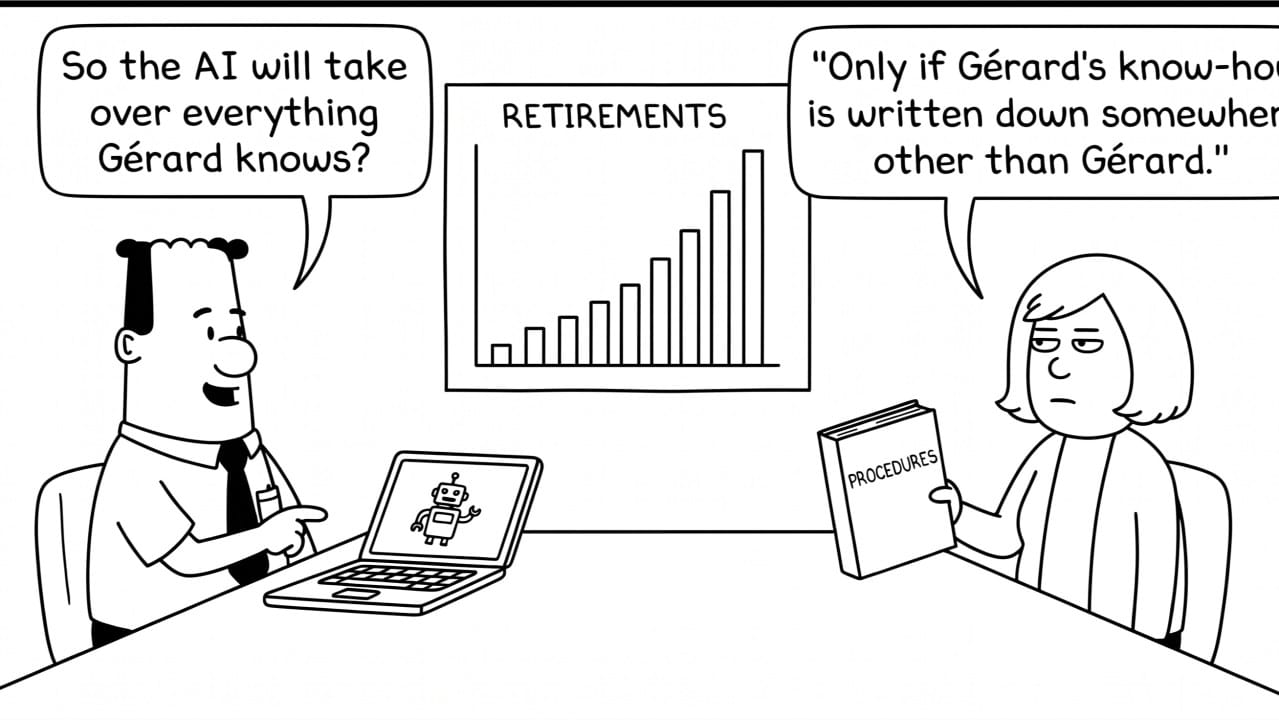
A CFO would call this a capacity and risk problem. Every unfilled role has a price, and every retirement takes away undocumented know-how that no system holds. Roger, thirty years in, knows which supplier lies about delivery dates. That sentence is not in the ERP.
Then comes the tempting answer: AI will cover the gap.
It will not, at least not on its own. Think of a new engine in a car with no steering column. More power, no control.
AI amplifies what is structured. If instructions, decisions and skills were never written down, AI amplifies the confusion, faster. This week's Gartner survey shows how far most organisations are from that discipline: only 4% of CIOs plan to redesign roles for a human-agent workforce, yet those that do are 2.4 times more likely to be top AI performers. And Microsoft's AI guidance, citing its Work Trend Index, puts 67% of realised AI value on organisational factors rather than individual behaviour. That Microsoft figure is vendor-cited with no stated sample, so read it as direction.
The impact differs by size:
- SMEs feel it first. Less flexibility, thinner benches, one retirement can stop a service.
- Large groups have the money but move slowly, and the sheer volume of departures overwhelms transformation programmes.
Where I expect it to bite earliest: healthcare, engineering and technical trades. That is my judgement, not a sourced ranking.
Yes, HR. The function everyone remembers when someone resigns, and forgets when the plan is written. This is the moment to be in the planning room.
That means moving from administration to workforce planning and ways of working redesign. Age profiles by role, time-to-fill by skill, internal mobility paths, and a simple scenario: what happens to this team if three of its seven senior people leave within 24 months? People analytics is the lens, but the output is a plain business question: which services are at risk, and when.
Many HR teams already hold the data for this and have never been asked to produce it.
What to do on Monday
- Build an exit map. List roles where a large share of staff is within ten years of retirement, and rank them by how hard they are to replace. One spreadsheet, no data team.
- Capture know-how before you automate. For your five most critical roles, ask the person to write down their ten hardest decisions and how they make them. That is the raw material any AI will need.
- Bring one number to the CFO: cost of an unfilled critical role per month multiplied by expected retirements in three years. Ask which budget line covers it today.
The demographic clock is the one deadline nobody can negotiate. The good news is that the work it demands is unglamorous and cheap: write things down, map the exits, plan the scenarios. Start with the roles that would hurt most, and start this quarter.
If your key people retired in 2028 or 2031, what would your AI actually have to work with?
Sources and credits:
- U.S. Bureau of Labor Statistics — Employment Projections 2024–34, via Indeed Hiring Lab (April 2026), "Why labor force participation is projected to fall through 2034"
- Congressional Budget Office — The Demographic Outlook: 2026 to 2056 (Jan 2026)
- Retirement Income Institute / Alliance for Lifetime Income — Peak 65 (about 4.1 million turning 65 per year)
- economiesuisse — "Demografische Entwicklung: Die Pensionierungswelle reisst grosse Lücken auf" (June 2023), citing BFS and BSV scenarios
- Gartner (via CIO Dive / HR Dive) — 2027 CIO and Technology Executive Agenda
- Microsoft — AI Strategy Roadmap, citing the 2026 Work Trend Index
Originally published in The Agentic HR Shift on LinkedIn.