The Agentic HR Shift — Edition 7, September 2026
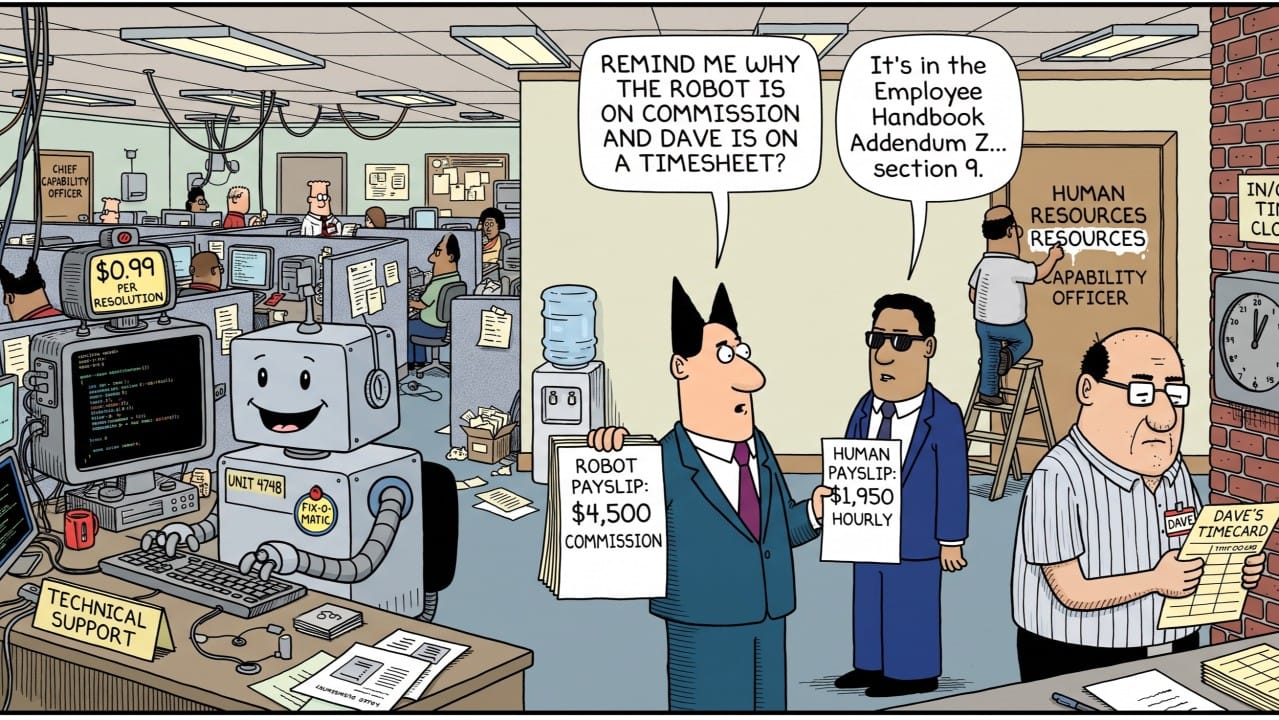
Paid for results, paid for presence: why the CHRO's next job is Chief Capability Officer, and why nobody can do it yet
The Headline Insight
Most large companies already run two pay systems under one roof. Their AI agents are billed per resolved outcome, while the humans sitting next to those agents are paid per hour, whether they resolve ten cases or forty. That asymmetry will not survive the decade. The executive who ends it, by owning every source of capability the company uses and pricing each one on what it contributes, is the role I call the Chief Capability Officer. The CHRO is the natural candidate, on one condition HR cannot yet meet: being able to say, with evidence, what a contribution is worth.
The Argument
The Shift
Intercom's customer service agent, Fin, is priced at $0.99 per outcome, and the client pays nothing when Fin fails and hands the conversation to a human. Read that pricing model slowly, because it is the most radical compensation policy in your company, and a software vendor wrote it. The digital worker is paid for contribution. The human worker is paid for attendance. We accepted outcome pricing for software in about two years. We have been paying people by the hour since the factory whistle.
The HoRizon Collective, a group of HR leaders convened by brooksmiller and Work Evolved, describes the destination well in a white paper published this year. Its first assumption is that pricing knowledge work by hours and location stops making sense once AI works around the clock. Its New Workforce Ecosystem puts employees, fractional leaders, consultancies and autonomous agents into one portfolio, and asks HR to move from managing employment to orchestrating productive capability. One detail in their taxonomy deserves more attention than they give it: they describe contractors as people paid for presence rather than output. That is also an accurate description of most salaried contracts. What the paper does not do, by its own account, is answer the reward question. It lists "how should organisations value contribution rather than time worked" among its open questions and schedules the answer for a 2028 playbook. That gap is what this edition is about.
The titles are already moving. Moderna made Tracey Franklin Chief People and Digital Technology Officer in November 2024, running HR and digital technology as one function. In April this year, Atlassian expanded Avani Solanki Prabhakar's role to Chief People and AI Enablement Officer, merging the People team with internal Customer Engineering and taking her organisation from roughly 700 people to 3,500. Neither title says capability. Both describe the same move: one executive accountable for how work gets done, whoever or whatever does it.
The Chief Capability Officer, as I define it, owns a single decision. For each piece of work, which mix of employees, agents, external services and external workers delivers the contribution at the best cost and risk, and what is each of them paid for it? Today that decision is split four ways. HR owns the employees, Procurement owns the contractors and service providers, IT owns the agents, and Finance owns the bill. Nobody sees the whole portfolio, which is precisely why nobody can price it.
Why It Matters for HR
The hourly wage made sense when input was visible and output was not. You could see someone at the machine; you could not easily see what their judgement was worth. AI flips that. Output is increasingly logged, versioned and attributable, while hours have become the least informative number on the payslip.
Two findings explain why companies will compete for contributors rather than heads. The first is about distribution. O'Boyle and Aguinis studied 633,263 researchers, entertainers, politicians and athletes across 198 samples and found that individual performance follows a power law, not a bell curve. The caveat matters: these are fields where output is countable. That is exactly the point. As AI makes knowledge work countable, your company will discover its own power law. Atlassian is already describing one: Prabhakar told the Financial Review Workforce Summit that the company's most advanced AI users are four times as productive as its most basic ones. That is a company figure with no published methodology, but the direction is hard to dismiss.
The second is about behaviour. When Edward Lazear studied Safelite Glass moving about 3,000 installers from hourly pay to piece rates, output per worker rose 44%, and roughly half of that gain came from who joined rather than from how hard people worked. The pay model acted as a magnet. Add last month's argument, that the working-age population across most of Europe is shrinking, and the logic closes. When heads get scarce, the firms that can recognise and pay for contribution will attract it, and the firms paying for attendance will get attendance.
Staying put has a cost too. KPMG and the University of Melbourne surveyed more than 48,000 people in 47 countries and found that 57% of employees admit to hiding their use of AI at work. Under time-based pay, that is perfectly rational. If I finish an eight-hour task in two, the gain belongs to my employer and my reward is more work. We built a pay system that taxes the exact behaviour every CEO is begging for.
The People Analytics Angle
You cannot pay for contribution you cannot see, and most organisations cannot see it. Rob Cross, Reb Rebele and Adam Grant, drawing on network data from more than 300 organisations, found that 20 to 35% of value-added collaborations typically come from just 3 to 5% of employees, and that leaders shown a list of their strongest collaborators were surprised by at least half the names. Now picture those names in a pay-for-contribution calibration session run by line managers. The people holding the organisation together would be the first to be underpaid.
Remove hierarchy and it gets worse. A 2026 systematic review of 75 studies on self-managing organisations by Díaz-Leyva and Cascón-Pereira, in Human Resource Management Review, found that when peers take over performance and pay decisions, the caring work of coaching colleagues and resolving conflict risks becoming an unpaid, implicit expectation. The invisible contributors become even more invisible.
This is where People Analytics stops being a reporting function and becomes the pricing engine of the Chief Capability Officer. Network analysis finds the contributions nobody logs. Productive capacity models put employees, contractors and agents into the same unit of account. Attribution in mixed human and agent workflows credits the person orchestrating six agents for the orchestration, not only for the keystrokes. None of this is exotic. Most mature PA teams already have the methods. What they lack is the mandate to apply them to pay.
There is also a deadline that has nothing to do with AI. The EU Pay Transparency Directive requires employers to give employees the criteria used to set pay and pay progression, and those criteria must be objective and gender neutral. Only four of the 27 member states, Slovakia, Italy, Lithuania and Malta, transposed it by the 7 June 2026 deadline, yet the first gender pay gap reports are still due in June 2027. Whatever you decide contribution means, a works council will soon be entitled to ask you to prove it. Contribution pay without a defensible measurement system is not a compensation strategy. It is a litigation strategy.
Now the uncomfortable part. Visier's analysis of 3.6 million employee records across more than 155 enterprises shows that the share of HR hiring going to workforce planning specialists fell by 67% over the period to May 2026. Visier is careful not to blame AI for it. I am less careful about the implication: companies are cutting the one HR capability that could model a portfolio of humans, services and agents, at the exact moment they need it.
The Contrarian Take
Everyone who likes this idea imagines the same scene: companies bidding for high contributors the way football clubs bid for strikers. I think that is the wrong war.
Boris Groysberg followed more than a thousand star equity analysts on Wall Street and found that those who changed firms suffered an immediate and lasting drop in performance. The main exception was stars who moved with their teams. Their excellence had partly belonged to their former firm: its resources, its colleagues, its networks. Microsoft's 2026 Work Trend Index, based on a survey of 20,000 AI users in 10 countries, points the same way. Organisational factors such as culture and manager support explained roughly twice as much of the reported AI impact as individual mindset and behaviour, 67% against 32%. It is a survey signal rather than a measurement, but if even half of it holds, paying individuals purely for their contribution means paying them, in large part, for their manager.
So the naive version of contribution pay makes two mistakes at once. It pays for what is countable, which is increasingly what the agents do, and it pays the individual for what the system produced. The companies that win will not be the ones that outbid everyone for the top 5%. They will be the ones that manufacture contribution, designing the workflows and the AI practice that turn a median performer into a strong one, then paying fairly for the difference. This is the literacy gap again, in compensation clothing. AI stretches the distribution. Chasing the tail is expensive; moving the middle is the actual strategy.
One more thing, from a Frenchman. My country legislated the 35-hour week. We are world champions at counting hours. What we never managed to count is what happened inside them. The hour will not disappear, and it should not: it is a floor that protects people from carrying risks they do not control, much as a minimum wage does. What disappears is the hour as the unit of value. Keep it as insurance. Stop using it as a price.
What This Means in Practice
Start with visibility, not with pay. Pick one end-to-end workflow, customer onboarding or month-end close, and build a capability ledger for it: every employee, contractor, service provider and agent that touches it, what each one costs and what each one delivers. You will need Procurement and IT at the table, because today they hold half the columns. That ledger is the Chief Capability Officer's first artefact, and it can exist within 90 days.
Before anyone designs contribution pay, run a network analysis on the same population. Find the people whose contribution appears in no system, and make sure any future model sees them. If it does not, the first thing contribution pay will do is push out the people who hold your organisation together.
Then write down, for two roles, what contribution means, at team level first and individual level second, and test the definition against the pay criteria your lawyers will need to disclose in 2027. If you could not defend it to a works council, you are not ready to pay for it.
Change one incentive now. When someone discloses an AI workflow that saves time, let them keep part of the gain, in money or in time. Otherwise your productivity will keep hiding in private workflows, and your transformation programme will keep measuring logins.
And if your company is cutting workforce planning analysts this year, reverse the decision. You are dismantling the Chief Capability Officer's finance team before the role exists.
One Thing to Watch
Watch how AI vendors define an outcome. Fin's billable outcome includes conversations where the customer simply leaves without asking for more help, and the rest of the market is arguing about what counts as a verified resolution. Those clauses, negotiated right now between procurement teams and agent vendors, are a dress rehearsal for the conversation HR will have about human contribution. Whoever writes the definition controls the price. Read your agent contracts with that in mind, and ask who in HR has seen them.
The Closing Provocation
Pick one role in your company and write down the definition of contribution you would pay it for. Could you defend that definition to your works council and to your best performer in the same meeting? And would the agent quoting for the same work pass the same test, more cheaply?
Sources & References
- The HoRizon Collective (brooksmiller + Work Evolved), The HoRizon Collective: Exploring the Future of Work in the Age of AI, white paper, 2026.
- Visier Insights, Hidden in the Headcount: The State of Workforce Transformation During the AI Reckoning, 2026 (Visier Community Data, 155+ enterprises, 3.6M employee records).
- Díaz-Leyva, C. and Cascón-Pereira, R., "Beyond formal managerial hierarchy: Reimagining HRM in self-managing organisations", Human Resource Management Review, 36 (2026), 101166.
- O'Boyle, E. and Aguinis, H., "The Best and the Rest: Revisiting the Norm of Normality of Individual Performance", Personnel Psychology, 65 (2012), 79-119.
- Lazear, E. P., "Performance Pay and Productivity", American Economic Review, 90(5), 2000, 1346-1361.
- Groysberg, B., Chasing Stars: The Myth of Talent and the Portability of Performance, Princeton University Press, 2010.
- Cross, R., Rebele, R. and Grant, A., "Collaborative Overload", Harvard Business Review, January-February 2016.
- KPMG and the University of Melbourne, Trust, Attitudes and Use of Artificial Intelligence: A Global Study, 2025.
- Microsoft, 2026 Work Trend Index Annual Report, May 2026.
- Atlassian: HRD Australia and Australian Financial Review coverage of Avani Solanki Prabhakar's expanded role and Financial Review Workforce Summit remarks, April 2026.
- Moderna, 2025 Proxy Statement (Form DEF 14A); UNLEASH interview with Tracey Franklin, April 2026.
- Intercom Fin published pricing, 2026; Aissist.io, AI Agent Pricing Benchmark 2026.
- Directive (EU) 2023/970 on pay transparency; transposition status per Morgan Lewis (June 2026) and the Trusaic transposition monitor (September 2026).
Originally published in The Agentic HR Shift on LinkedIn.