The Agentic HR Shift — Edition 6, August 2026
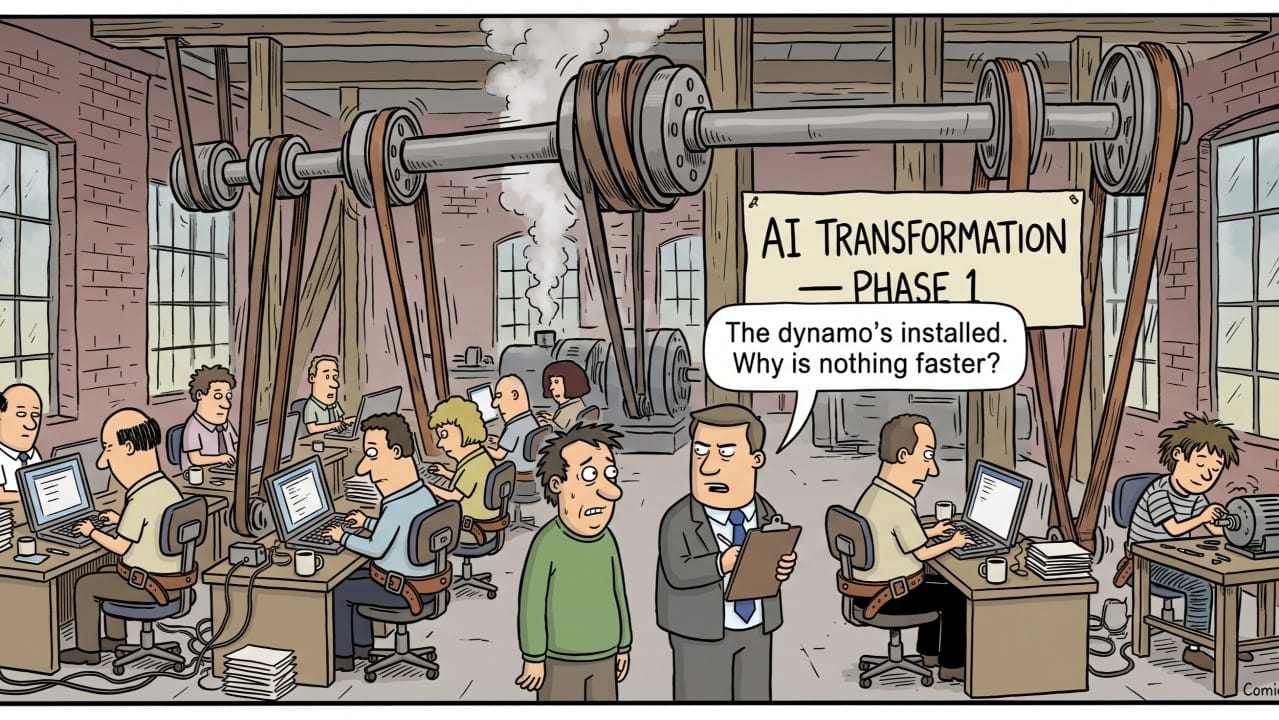
Everywhere but in the productivity statistics
The Headline Insight
Gartner's 2026 Hype Cycle for agentic AI, its first standalone one, places the technology at the peak of inflated expectations, while generative AI has moved into the trough of disillusionment. Most of the industry is reading this as the story deflating. It is the story starting. Every general purpose technology in the last two centuries produced its economic returns only after organisations rebuilt themselves around it, and the rebuild took decades. What is different this time is that we do not have decades, because the workforce that would have absorbed the wait is already contracting. (Gartner hype-cycle-for-agentic-ai)
The Argument
The Shift
Two facts sit awkwardly together right now. The first is that enterprise deployment is thin. Gartner's 2026 CIO and Technology Executive Survey found 17% of organisations have deployed AI agents, against more than 60% expecting to within two years, and Gartner expects over 40% of agentic projects to be cancelled by the end of 2027 on cost, unclear value, or weak risk controls. The second is that capital is not waiting for any of that. The five largest hyperscalers are guiding to roughly $775 to $800 billion of infrastructure spend in 2026, with the 14 largest data centre operators near $750 billion against a little under $450 billion last year.
That gap between thin adoption and enormous capital is exactly what Carlota Perez described in 2002, writing at the moment the dot-com sceptics believed they had been vindicated. Her account of five technological revolutions found the same sequence each time: speculative capital funds an installation phase that builds the infrastructure, a crash follows, and then a deployment phase in which institutions adapt and the technology spreads far more widely than the original frenzy suggested. The fibre that carried the post-2000 internet was paid for by investors who lost everything on the companies that laid it. The bubble is not evidence the technology failed. It is how the infrastructure gets bought. (Substack the-ai-installation-bubble)
So the honest position in September 2026 is not "AI is overhyped" and not "AI changes everything now." It is that we are late in installation and early in deployment, and the two feel identical from the inside.
Why It Matters for HR
The best explanation of what happens next was written in 1990 about 1890. Paul David's paper on the dynamo and the computer noted that electric motors supplied under 5% of factory mechanical drive power as late as 1899, and the productivity gains did not appear until the 1920s, two decades after the first power stations. His line about the dynamos being visible everywhere except in the productivity statistics has been recycled for every technology since, usually without the explanation attached to it.
The explanation is the part that matters for anyone running an HR function. Nineteenth century factories were built around a single central steam engine, with power distributed to every machine through drive shafts, belts and pulleys, and everything from the building's layout to the placement of machines was designed to minimise distance from that shaft. Early electrification changed almost nothing: owners kept the centralised mechanical system and swapped the steam engine for a dynamo. The gains arrived only in the 1920s, when factories moved to unit drive and gave each machine its own motor. The constraint was never the electricity. It was that nobody rebuilds a working factory. (Substack the-dynamo-the-computer-and-chatgpt)
HR is at the swap-the-engine stage. The org chart is the drive shaft. Copilots are being distributed along the existing belts, into the same COE structure, the same HRBP layer, the same ticket queues, and the results are being measured against the process that was already there. Then everyone is surprised that the productivity did not show up.
The People Analytics Angle
Here is where the function earns its position, and it is not where the industry thinks.
The macro evidence on AI and employment is currently contradictory, from sources that are all credible. Stanford's payroll-based study found entry-level employment in the most AI-exposed occupations down 6% from late 2022 to July 2025, while older workers in the same occupations grew 6% to 9%. Anthropic's own labour market research found no impact on unemployment rates in the most exposed occupations, with a 14% drop in job-finding rates for young workers that was barely statistically significant. The New York Fed, working from job postings, concluded that AI is contributing to labour market developments but is not the main driver of the hiring slowdown, noting the divergence began before ChatGPT was released. (first-kind-stanford-study-says)
Three serious research teams, one labour market, three different answers. And that is before the definitional problem: Gartner asked 2,501 CIOs and got 17% deployed, while the vendor Writer surveyed 2,400 people and got 97%, and both figures are currently sitting in board decks, sometimes the same one. The word "deployed" is doing entirely different work in each sentence. (how-many-companies-have-actually-deployed-ai-agents)
If the external evidence cannot settle the question, the answer only exists in one place, which is inside your own organisation's data. That is the People Analytics mandate for the next eighteen months, and it is a considerably better mandate than the one the function usually gets. Not "will AI take jobs," a question no CFO has ever been able to act on, but which decisions in our operating model can now be made differently, what that does to the capacity we need in 2030, and where our own entry-level pipeline is quietly closing while nobody measures it. A function that can answer those three questions with its own evidence is worth more than one that can benchmark itself against a survey.
The Contrarian Take
Now the part the industry is getting backwards.
The demographic picture is not a forecast, it is arithmetic that has already happened. The OECD's own framing is that the working-age population across OECD countries has now started to decrease and is projected to keep falling through 2060. By 2060 it will be down 8% across the OECD and by more than 30% in over a quarter of member countries, with the old-age dependency ratio rising from 31% in 2023 to 52%. On unchanged productivity, GDP per capita growth falls by roughly 40%, from 1.0% a year to 0.6%. (OECD editorial-from-job-shortage-to-labour-shortage-the-new-challenge-of-population-ageing)
Set against that, the industry's headline prescription for HR is a function operating with 30 to 40% fewer people, which is what The Josh Bersin Company's 2026 research on superagents argues, alongside a claim that 60 to 70% of current L&D work can be automated. Both may well be technically true. Both are also the steam-engine answer. If the binding constraint on the next twenty years is that there will not be enough working humans, then optimising for a smaller HR department is solving the wrong problem with genuinely impressive precision.
BCG's Henderson Institute scenario work makes the point without meaning to. Labour productivity growth in high-income countries runs at 2.0% today. Across their four scenarios for 2050, the endpoints range from 1.0% to 5.7%. The technology is present in all four. What separates them is governance, energy, and whether organisations actually reorganised around the tools. Three of the four land at or below where we are now. The productivity dividend is not a property of the technology. It is a property of what institutions do with it, which happens to be the thing HR is for.
The energy objection deserves the same treatment. The IEA expects data centre electricity consumption to roughly double from 485 TWh in 2025 to 950 TWh in 2030, reaching around 3% of global demand, with gas and coal meeting over 40% of the additional demand to 2030. Real, and worth arguing about. Also a technology whose power consumption per task is falling by at least an order of magnitude annually, a rate the IEA believes is unprecedented in energy history. Electricity, the car and the internet all arrived with the same objection attached. It was a constraint to be engineered, never a reason to sit the transition out. (IEA executive-summary)
What This Means in Practice
Stop reporting AI adoption. A percentage of licensed users tells your CEO nothing they can act on. Report decisions changed: which recurring decision is now made faster, with better evidence, or by someone different. If you cannot name three by December, you have distributed copilots along the drive shaft.
Build a productive capacity model rather than a headcount plan. Take your critical roles, in your actual locations, and model what the demographic curve removes from the available pool by 2030. Then split the gap into what redesigned work absorbs and what you must still hire. This is a two-week analysis with public data, and it reframes every conversation you will have with your CFO next budget cycle.
Rebuild one process end to end instead of adding assistants to twelve. Choose the one where the existing structure is most obviously in the way, usually somewhere between recruiting, mobility and workforce planning, and accept that the first version will be worse before it is better. That was true in 1920 too.
Instrument your own labour market now. Track internal hiring, time to competence and early attrition, cut by AI exposure. In eighteen months you will either have your own evidence or you will be quoting someone else's survey to a board that has read a different one.
One Thing to Watch
The Stanford Digital Economy Lab updated its "Canaries in the Coal Mine" analysis in August 2026, still finding that firms have contracted hiring for exposed young workers beyond structural replacement rates. Watch whether that divergence survives the next round of postings-based work from the New York Fed, which currently disagrees. Whichever way it resolves will reset how every workforce plan in your industry gets written.
The Closing Provocation
Your 2027 budget almost certainly assumes AI makes your function cheaper. Your 2032 workforce does not exist to be made cheaper, because it will not exist in sufficient numbers at all. Which of those two assumptions is actually written into your workforce plan, and who signed it off?
📚 Sources & References
- Gartner, 2026 Hype Cycle for Agentic AI and Hype Cycle for Artificial Intelligence (2026); 2026 Gartner CIO and Technology Executive Survey, n=2,501, fielded June 2025
- Carlota Perez, Technological Revolutions and Financial Capital (2002), via Nick Wade, "The AI Installation Bubble," State of Play (June 2026)
- Paul A. David, "The Dynamo and the Computer: An Historical Perspective on the Modern Productivity Paradox," American Economic Review (1990)
- OECD, Employment Outlook 2025: Can We Get Through the Demographic Crunch?
- BCG Henderson Institute, Beyond Tomorrow: Four Scenarios for the World of 2050 (April 2026)
- Erik Brynjolfsson et al., "Canaries in the Coal Mine," Stanford Digital Economy Lab (August 2026 update)
- Anthropic, "Labor Market Impacts of AI: A New Measure and Early Evidence" (March 2026)
- Federal Reserve Bank of New York, "Do Job Postings Show Early Labor-Market Effects of AI?", Liberty Street Economics (May 2026)
- IEA, Key Questions on Energy and AI (2026) and Energy and AI
- BloombergNEF data centre capex tracking (2026); AL Capital Advisory hyperscaler capex analysis (August 2026)
- The Josh Bersin Company, The Superworker Organization: AI Goes Enterprise (January 2026)
Originally published in The Agentic HR Shift on LinkedIn.