The Agentic HR Shift — Edition 5, July 2026
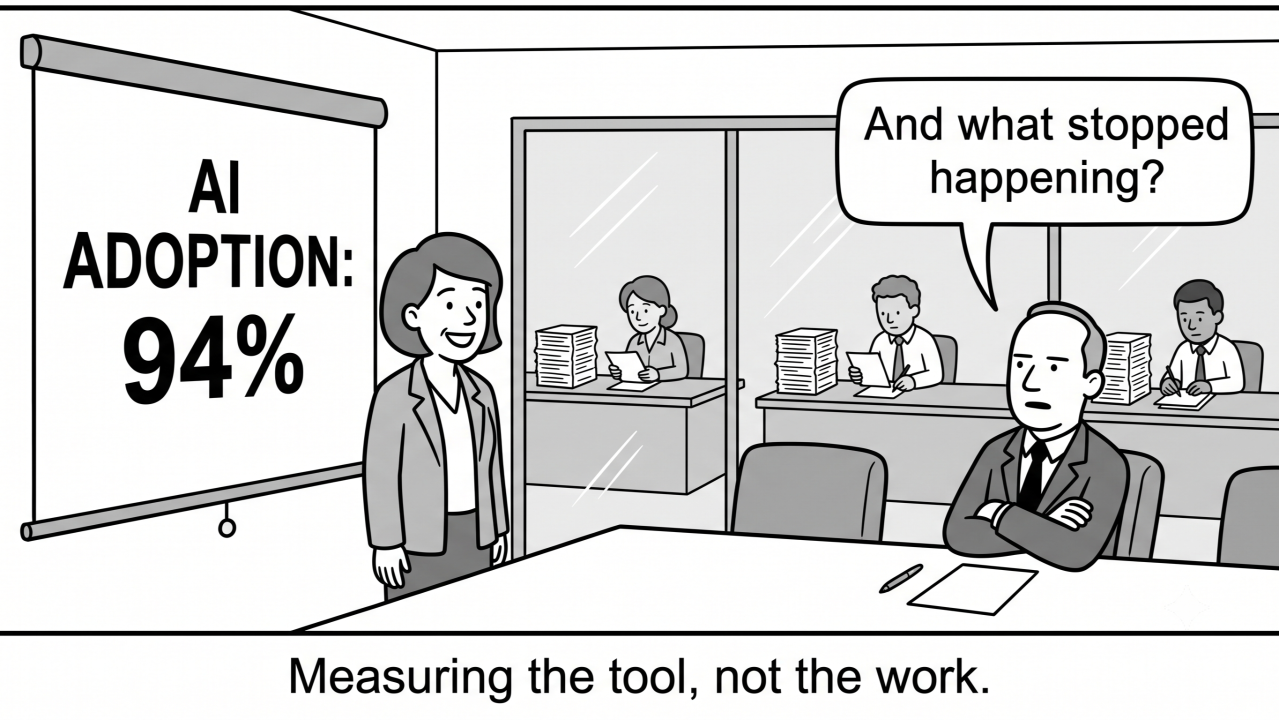
Your AI adoption rate is a vanity metric. Here are the two numbers that replace it.
The Headline Insight
Access is no longer the constraint. Gallup's Q2 panel puts organisational AI integration at 47% of US employees, up six points in a single quarter, with individual use crossing half the workforce for the first time. In the same three weeks, ManpowerGroup found that 3% of organisations rate their leaders as highly prepared to manage AI-enabled ways of working. The distance between those two numbers is the entire story of 2026, and every AI metric currently sitting in a CHRO's board pack is on the wrong side of it.
The Argument
The shift: depth, not reach
Gallup's most useful finding this quarter is a gradient, not a headline. Among workers applying AI to one or two types of task, 45% report a productivity gain. At three or four types, 66%. At five or six, 78%. At seven or more, 90%. Double the return, and the variable is not the tool, the licence or the vendor. It is how many distinct places in a person's work the thing has actually landed.
Then look at where it lands most often. The top uses are writing and editing at 51% and search at 49%. These are the ask-a-question-get-an-answer tasks. They make an existing step faster without changing what the step is for. High volume, shallow depth.
ManpowerGroup and Everest Group, surveying 80 C-suite and senior talent leaders in July, found the same pattern from the design side. Thirty-four percent of organisations report their strongest productivity improvements in AI-augmented roles where the workflow was rebuilt, against 8% reporting their best gains from roles that were fully automated. Redesign outperforms automation by a factor of four, and almost nobody is doing it.
Microsoft's 2026 Work Trend Index puts a number on how rare it is. Of 20,000 AI users surveyed, 16% qualify as what Microsoft calls Frontier Professionals: people who routinely rebuild their own workflows around what agents do well, run multi-step agent work, and write down standards others can copy. That group reports producing work they could not have produced a year ago at 80%, against 58% for everyone else. The same study finds organisational conditions such as culture, manager behaviour and talent practice account for roughly 67% of AI's measured impact, against 32% for individual capability.
Now set all of it against the NBER survey of nearly 6,000 executives across four countries, where 89% report no measurable effect of AI on their firm's labour productivity over three years. Both things are true at once. Individuals are getting faster. Firms are not getting more productive. The transmission belt between the two is workflow redesign, and in most organisations it is simply absent.
Why it matters for HR
Every AI number currently reported to an executive committee measures distribution. Licences deployed. Percentage of the function with access. Training completions. Adoption rate. These are procurement metrics wearing a strategy costume. They confirm the tool arrived. They say nothing about whether any work changed.
They are also self-flattering by construction. Adoption rate rises when you buy more seats. It rises again when you mandate a login. It never falls when the work underneath stays exactly as it was, which is precisely the failure mode the evidence now points at.
This lands harder in HR than anywhere else, because HR is where the redesign decision actually gets made. Nobody else in the building owns job architecture, role design, or the question of what a job is for. If work is not being rebuilt around AI, that is not an IT gap. It is an HR gap, and right now it is being reported upward as a technology adoption success.
The People Analytics angle
Here is the part nobody has claimed yet. The two variables that predict return are both people-data problems, and People Analytics is the only function with a plausible route to either.
The first is use-case breadth per employee. Not "do you use AI" but "in how many distinct parts of your work". Gallup has demonstrated the gradient across a national panel; nobody has operationalised it inside a single company. The raw material already exists in tool telemetry, in survey instruments most PA teams run twice a year, and in workflow logs. Build the distribution of use-case breadth across the workforce, then cut it by function, by tenure and by manager, and a CHRO can see exactly where AI has landed and where it is decorative. That is a two-quarter build with capability most teams already have.
The second is redesign count: how many workflows have had a step removed rather than accelerated. Removed. Not made faster. If a process still carries the same handoffs and the same approvals but each one moves quicker, nothing structural happened, and the time saved gets reabsorbed within two cycles. This number is harder to instrument and much easier to audit. Take the ten highest-volume processes in the function and ask, for each one, which step no longer exists.
Neither number requires new technology. Both require the thing People Analytics is supposed to be good at and frequently is not: framing a question the business actually cares about, and answering it with evidence somebody can act on.
There is a self-interested argument here too, and it deserves stating plainly. Insight222's 2025/26 study, covering 372 organisations, found that sustained investment in people analytics improves how organisations realise value from AI. Good. But that finding only cashes out if PA measures the variable that predicts value rather than the one that is easy to count. Otherwise it is a correlation waiting to be embarrassed.
The contrarian take
The consensus answer to all of this is AI literacy. Teach everyone to use the tool. I have argued for upskilling repeatedly and I still do, but the literacy framing is quietly repeating the mistake People Analytics made with dashboards for a decade. It optimises for the ability to operate the instrument, and then assumes value follows. It does not.
Culture Amp's July benchmark of 264 HR professionals found only 24% comfortable deploying agentic systems, with comfort tracking hierarchy almost perfectly: 37% among the HR C-suite, 16% among individual contributors. The people least comfortable are the ones who will be running the redesigned workflows. Another literacy module will not close that. It is not a knowledge gap, it is a question of who was in the room when the work was designed.
Then there is the measurement version of the same error, and it is instructive. In February, Meta became the first large technology company to formally tie performance reviews to AI usage, with AI-driven impact now a stated expectation for every employee. Read that as an HR design decision rather than a headline. You have just told a workforce that using AI is scored. You will get usage. You will get a spectacular amount of usage. You will not necessarily get one redesigned workflow, because that is not what you measured, and people are extraordinarily good at producing the number they were asked for. Measure usage and you get usage. It is the oldest failure in performance management, and HR is about to run it at scale on itself.
What This Means in Practice
Stop reporting AI adoption rate to your executive committee. It is the headcount-and-turnover of the AI era: easy to produce, impossible to act on, and quietly reassuring in a way the underlying situation does not justify.
Replace it with two numbers this quarter. The first is the distribution of use-case breadth across your workforce, segmented by function and by manager, because Gallup's gradient says your return lives in the tail of that distribution and you currently cannot see it. The second is a redesign count: of your top ten processes, how many have had a step permanently eliminated. If the answer is zero, you do not have an adoption problem. You have a design problem, and further deployment will not touch it.
For the CHRO, one decision follows. Somebody has to own workflow redesign, and it will not be IT, because IT does not own job architecture. Name that owner before the end of the quarter and give them a mandate to remove steps rather than accelerate them. The ManpowerGroup finding on leadership readiness is usually read as a training gap. It is an accountability gap, and it does not close on its own.
And if you lead People Analytics and you are wondering where the function goes as agents absorb the reporting layer, this is where. Reporting is being automated. Measuring whether the automation actually worked is not.
One Thing to Watch
Novo Nordisk. More than 25,000 employees have built over 2,500 chatbot use cases on a self-service generative AI platform, at an average operating cost of roughly $10 per chatbot per month, and one workflow, clinical study report production, has gone from more than ten weeks to ten minutes. That is not an adoption statistic. It is a breadth statistic and a redesign statistic occurring in the same organisation, which is why it is worth more than another vendor survey. The question worth asking is not how they built it. It is how they measured it.
The Closing Provocation
If your CEO asked tomorrow how many workflows in HR have had a step permanently removed since you started using AI, could you answer without going to look? And if you did go and look, would the answer be zero?
Sources & References
- Gallup, "Organizational AI Adoption Jumps Six Points," 20 July 2026 (Q2 2026 workforce panel, n=22,573 employed US adults)
- ManpowerGroup Talent Solutions with Everest Group, "The New Talent Equation: Activating Workforce Confidence at Scale," 22 July 2026 (n=80 C-suite, CHRO and senior talent acquisition leaders, US and UK)
- Microsoft, 2026 Work Trend Index, "Agents, Human Agency, and the Opportunity for Every Organization" (20,000 AI users surveyed; Frontier Professionals n=3,233)
- NBER Working Paper 34836, executive survey on AI and firm labour productivity (approx. 6,000 executives, four countries)
- Culture Amp, "2026 AI in HR Study: Transformation Gap," 22 July 2026 (n=264 HR professionals, North America, EMEA, APAC)
- Insight222, People Analytics Trends 2025/26 (372 organisations, 20M+ employees, 180 countries)
- SHRM, "Navigating AI in the Workplace: 2026" (n=5,875 US workers)
- Novo Nordisk generative AI platform case data, via AWS
- Meta performance review policy tying evaluation to AI-driven impact, February 2026, first reported by Bloomberg
Originally published in The Agentic HR Shift on LinkedIn.