The Agentic HR Shift — Edition 3, May 2026
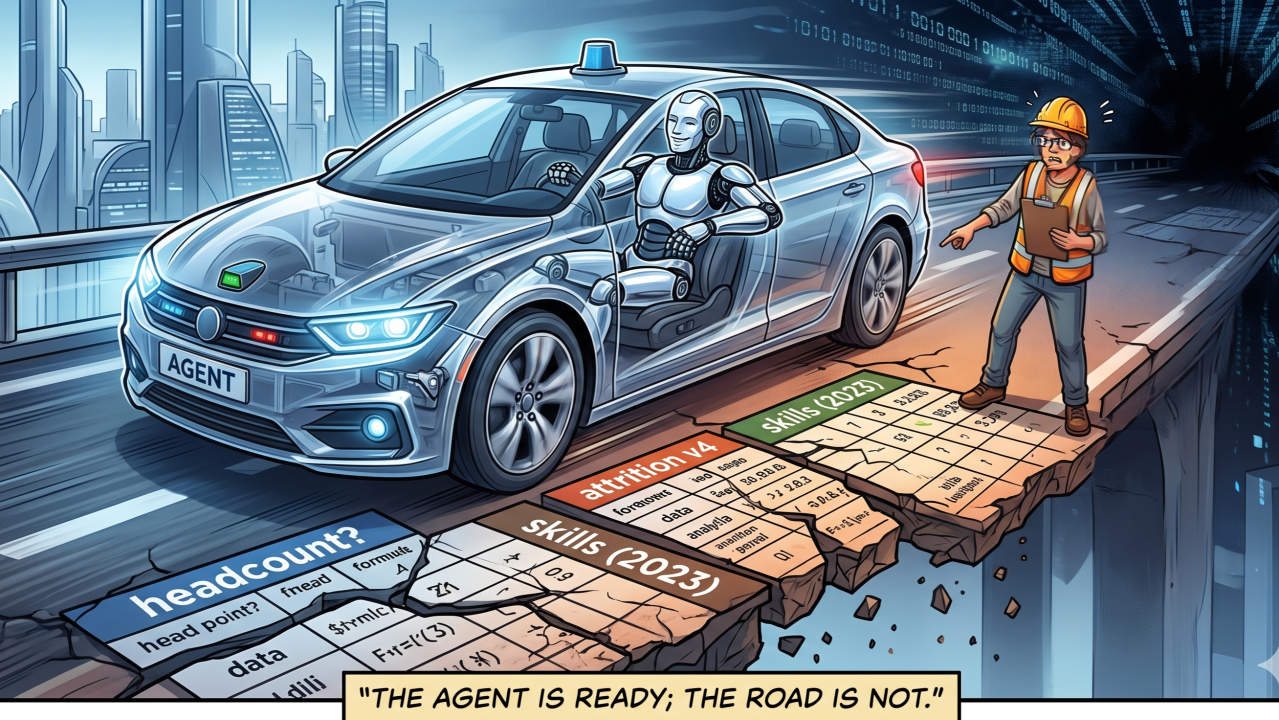
𝑃𝑒𝑜𝑝𝑙𝑒 𝐴𝑛𝑎𝑙𝑦𝑡𝑖𝑐𝑠 𝑎𝑠 𝑡ℎ𝑒 𝐴𝐼 𝑜𝑟𝑐ℎ𝑒𝑠𝑡𝑟𝑎𝑡𝑖𝑜𝑛 𝑙𝑎𝑦𝑒𝑟 - 𝑡ℎ𝑒 𝑠𝑡𝑟𝑢𝑐𝑡𝑢𝑟𝑎𝑙 𝑎𝑟𝑔𝑢𝑚𝑒𝑛𝑡
The Headline Insight
In the last twelve months, Workday, SAP, UKG, Gloat, Cornerstone, and Microsoft have all shipped agentic HR. The agents are real, they act across systems, and they are already in your stack. Here is the part the launch decks skip: an agent is only as good as the data it acts on, and 48% of IT leaders say their data foundation cannot support agentic AI yet. The bottleneck moved. It is no longer the technology. It is whoever owns the data layer underneath it. In most companies, that is People Analytics, even where nobody has said so out loud.
The Argument
The Shift
Buy a single category of software in 2026 and you will struggle to find one without an agent attached. Workday narrowed its agent programme to fifteen focused projects and now ships AI that can start and finish an HR transaction on its own rather than answer a question about it. Gloat launched Gloat Agentic HR, a toolset that builds agents on top of the rules already living in Oracle, Workday, or SuccessFactors and runs them inside Teams, Slack, and Copilot. Cornerstone put its People Graph and a 55,000-skill engine underneath agentic orchestration. The vendor language has converged on one word: orchestration. Josh Bersin describes a five-layer architecture topped by "Superagents" that stitch the smaller functional agents together, and in his HR 2030 work he names "AI Orchestration" as a genuinely new HR role, building and architecting the agents that run HR processes.
So the capability is shipping. The trouble is what it runs on. A separate read of the same year is less flattering. Fewer than one in ten HR teams can connect people data to a business outcome. Across all functions, 95% of organisations report no measurable return on AI investment. And the most quoted figure in People Analytics circles right now is that 85% of People Analytics and AI projects fail, with the cause located not in the algorithms but in data architecture built for operational convenience rather than intelligent consumption. Agents do not fix that. They inherit it.
Why It Matters for HR
An agent is a decision that executes itself. When a recruiting agent screens a candidate, schedules the interview, and drafts the offer, it is making compensation, fairness, and risk calls at every step, and it is making them at the speed of software. If the skills taxonomy is three years stale, the agent scales a stale taxonomy. If "regrettable attrition" means four different things across four systems, the agent picks one and runs. The old failure mode of bad HR data was a wrong number in a slide nobody read. The new failure mode is a wrong decision, executed thousands of times, before anyone opens the dashboard.
This is why the EU AI Act matters more than the launch keynotes admit. From 2 August 2026 most high-risk employment use cases fall under its obligations, with fines that reach into the tens of millions. An agent that issues an incorrect notice or acts on a hallucinated policy does not absolve the employer. The organisation still owns the outcome. Which means the question is no longer "which agent do we buy." It is "who governs what the agent is allowed to believe." That is a data-definition question, an audit-trail question, and an outcome-measurement question. HR has historically been weak at all three.
The People Analytics Angle
Here is the structural argument, and it is simpler than the vendor diagrams make it look. Agents need four things to be trustworthy: clean, connected data; agreed definitions; a line from any action back to a business outcome; and a record of why a decision was made. Exactly one function in HR already does all four for a living. People Analytics sits on the data layer. It is the team that already fought the war over what "headcount" means. It already speaks in revenue per employee and retention lift rather than survey averages. And it is the only group in HR with the instinct to ask whether a model is actually right before it ships.
That makes People Analytics the orchestration layer by function, not by title. Orchestration is not a dashboard and it is not a chatbot. It is the governance of what agents are permitted to do and the evidence of whether they did it well. Cornerstone built its agentic layer on a People Graph for a reason: the graph, the definitions, and the inference sit underneath the agents, not beside them. The companies that win the next eighteen months will be the ones that recognise their People Analytics team was already standing on that layer, and resource it as infrastructure rather than as a reporting service that produces slides on request.
The Contrarian Take
The consensus says orchestration is something you buy. Every vendor on the list above will sell you an orchestration layer this quarter. That is the expensive misunderstanding of 2026. Orchestration is not a SKU. It is a capability that either exists inside your People Analytics function or does not, and no platform purchase creates it where it is absent. Buying an agentic platform on top of fragmented data and contested definitions does not give you orchestration. It gives you your existing mess, automated, faster, and now subject to a regulator. The cruel irony is that the companies most eager to "deploy agents this year" are often the least ready, because eagerness to automate is not the same as readiness to be trusted. The CHRO who slows down to fix definitions and data lineage first will, within two years, look like the only adult in the room. The ones who shipped agents on a 2018 data model will spend 2027 explaining to their board why nothing improved and something broke.
What This Means in Practice
Stop evaluating agents on features and start evaluating your own readiness to be orchestrated. Before any agentic platform decision, a People Analytics leader should be able to answer three questions in writing: which of our people-data definitions are agreed and which are contested; which decisions, if executed autonomously, carry regulatory or fairness exposure; and for any agent we switch on, can we trace its action back to a business outcome and an audit record. If you cannot answer those, you are not buying orchestration, you are buying risk with a nicer interface.
For the CHRO, the move this quarter is to reposition People Analytics from a reporting service to the governance layer for agentic HR, and to fund it accordingly. That means giving the PA lead a seat in every agent procurement conversation, not a request ticket afterwards. For the PA leader, the priority is unglamorous and decisive: data lineage, definition governance, and outcome linkage, in that order, before a single agent goes live in production. The work that looks like plumbing is the work that turns out to be strategy.
One Thing to Watch
Watch what Workday does next. Its move from "system of record" to "platform of agents" is the clearest signal of where the incumbent HCM vendors are heading, and it sets the integration default for everyone standardised on the platform. If Workday's agents become the path of least resistance, the orchestration question stops being theoretical and lands on every CHRO's desk by year-end. The vendor roadmap is now a workforce-strategy input, not an IT footnote.
The Closing Provocation
If an agent in your HR stack made a decision today that violated your own policy, how long would it take you to notice, and could you prove who was accountable? If you do not have a confident answer, you do not have an orchestration problem. You have a governance gap that agentic AI is about to make very expensive. So who owns that gap in your organisation, and have they been told?
📚 Sources & References
- Workato, "Agentic Orchestration: Driving the Future of Enterprise AI," May 2026.
- Workday, "Workday Delivers Next Wave of Agentic AI to Power the New Work Day," March 2026; and "The Reinvention of Workday: From System of Record to Platform of Agents," April 2026.
- Josh Bersin, "Gloat Enters The Crowded War For AI Agents in HR," March 2026; "Introducing HR 2030: A Vision For Agentic Human Resources," April 2026; "The Great Reinvention of Human Resources Has Begun," January 2026.
- Cornerstone, "Cornerstone Launches Cornerstone Workforce AI," May 2026.
- ClearCompany, "Is Your Data AI-Ready? 5 Benchmarks for HR Tech Maturity," May 2026 (48% data-foundation and 95% no-return figures).
- Lumenai Labs, "People Data Maturity and AI Enabled Workforce Intelligence: The 2026 Imperative" (85% project-failure and Data Readiness Levels framework).
- Financier Worldwide, "The Agentic Workforce Arrives: AI and the HR Transformation," April 2026 (EU AI Act, 2 August 2026, high-risk classification).
- Viewpoint Analysis, "HR AI Software Options 2026" (Workday Illuminate, fifteen agent projects).
Originally published in The Agentic HR Shift on LinkedIn.