The Agentic HR Shift — Edition 2, April 2026
HR Just Ran Out of Excuses: April 2026 and the Death of "We Need More Time"
The Headline Insight
For three years, HR has been allowed to treat agentic AI as a future problem. April 2026 was the month that defense expired. The vision is now public, the case studies are named, and the function's leading voices have admitted no one owns the transformation. The CHROs who do not act this quarter are choosing to be acted upon.
The Shift
April 2026 collapsed three excuses simultaneously, and they were the three excuses HR functions had been running on since 2024.
The first excuse was that nobody really knew what agentic HR meant. That excuse died on April 6 when Josh Bersin published "HR 2030," the most concrete articulation of an agent-driven HR operating model produced to date. Bersin's framework fuses his Systemic HR model with a Superagent architecture in which AI agents draw on employee data (skills, schedules, history) and external market data (pay benchmarks, regulatory shifts) to operate hiring, pay, scheduling, training, and mobility as one continuous workflow. The vision was specific. So were the names of the companies already executing on it: Microsoft, Roblox, Google, Mastercard, ServiceNow. The "we don't know what this looks like" defense ran out of road.
The second excuse was that the platforms were not ready. That excuse weakened on April 18 with Bersin's piece on Microsoft's enterprise AI war, then collapsed on April 27 when Workday's repositioning from system of record to "platform of agents" went live, with Bersin documenting the strategic shift the same day. The largest HR platform in the world is now publicly betting that agents are the operating layer of HR by 2027. Vendors are no longer the bottleneck. The platforms are arriving on schedule whether HR is ready or not.
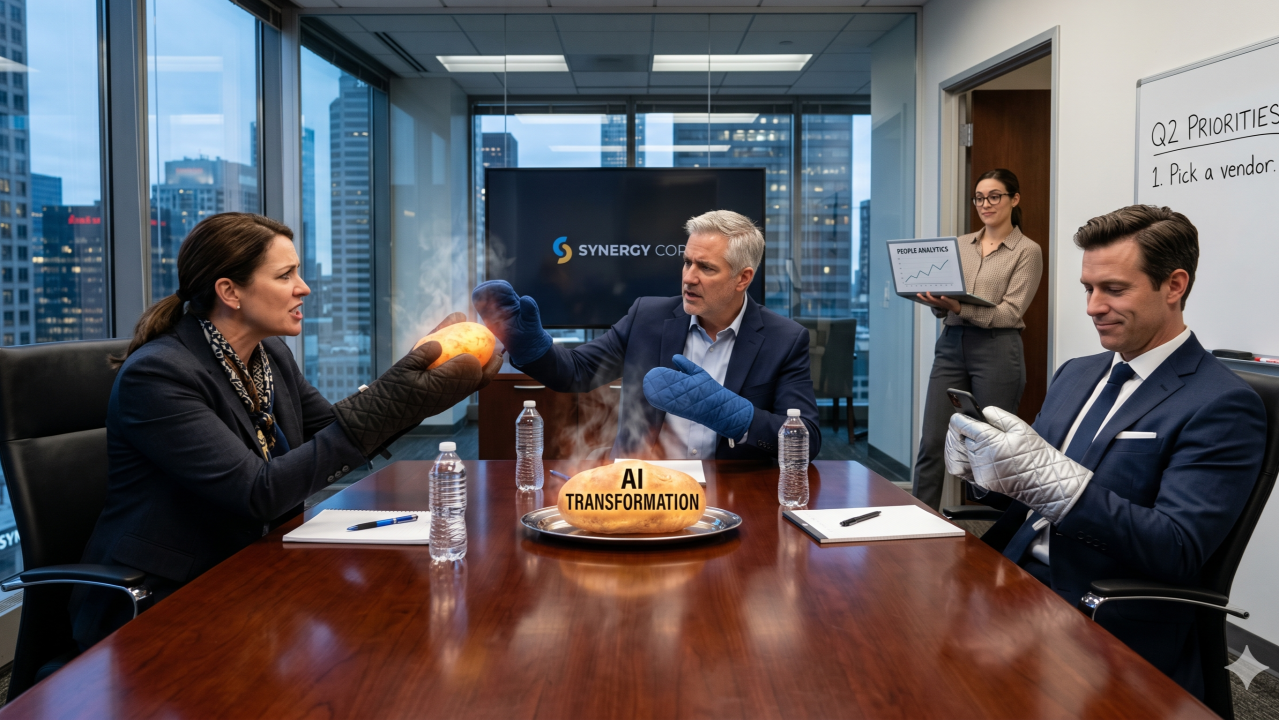
The third excuse, the one HR rarely admitted out loud, was that this was someone else's problem. That excuse died at the UNLEASH America CHRO summit, where Stacia Garr surfaced what she called the "hot potato problem." Her formulation, repeated across April interviews, was direct: IT does not fully own AI transformation, HR is not sure it is theirs, and business leaders do not know how to do it. The potato keeps moving because nobody wants to be holding it when something breaks. By admitting it publicly, HR gave up the option of pretending it was being solved elsewhere.
Three excuses, three burials, one calendar month. That is the news.
Why It Matters for HR
The implication is structural, not tactical. If agents can operate the full hiring cycle, the boundaries between Talent Acquisition, Compensation, and HR Operations dissolve. If an agent can run pay benchmarking against external market data and recommend adjustments, the COE's job description changes. If an agent can predict attrition risk, recommend interventions, and route a case to a manager with a draft script, the HRBP's value proposition is no longer "presence with the business." It is judgment about what the agent should not be allowed to do.
Bersin's research, drawn from his Galileo job database, suggests 30 to 40 percent of existing HR jobs can be automated with relatively low effort. That number is not a layoff number. It is a redesign mandate. And the function being redesigned cannot lead its own redesign without a separate function holding the architecture.
Garr's argument late in April was the more uncomfortable half of the same point. When AI transformation is led by IT or by business units, HR's influence does not hold steady. It declines. The hot potato is not stuck in midair because nobody can catch it. It is stuck because catching it requires a function HR has not yet built.
The People Analytics Angle
The function exists. It is just under-scoped.
People Analytics is the only HR sub-function that already sits on the data layer, speaks the language of evidence over process, and engages the business on outcomes rather than activities. In every other domain that went through this transition (finance, marketing, supply chain), the analytics function became the orchestration layer when the operating model shifted. There is no reason HR is structurally different. There is only the historical accident that HR scoped its analytics team as a reporting team and never updated the job description.
Cole Napper's reframe in his April Substack piece, "Three Meanings of Intelligence," is doing exactly that updating. People Intelligence is not a rebrand. It is a posture change: from dashboard service to decision engine. The function governs what the agents see, what they can decide autonomously, what they escalate to humans, and what outcomes get measured. None of that work is reportable. All of it is essential.
The structural argument is straightforward. Agents need a control layer. The control layer requires data fluency, business credibility, and the operating muscle to challenge a decision. Among existing HR functions, only People Analytics has all three. Most PA functions today have none of them at the level required, but the gap is closeable in 12 to 18 months. The gap between an HRBP function and an agentic control layer is not.
The Contrarian Take
Q2 2026 will be spent in vendor evaluations. Workday or Microsoft. Gloat or Eightfold. Build or buy. Most CHROs will treat this as the strategic question.
It isn't. It's a downstream procurement question dressed up as strategy.
The actual question is structural. Which function in your HR organization has the operating posture to absorb agent orchestration? If you cannot name one, no vendor decision will rescue you. If you can name one and it is not People Analytics, you are working from a definition of PA that is about to expire. And if you can name PA but your PA team is producing weekly headcount reports and quarterly engagement surveys, you have a function label without the function underneath it.
Vendors prefer the current conversation. They benefit when the question is framed as platform selection. They do not benefit when the question is whether you have anyone capable of operating the platform once it arrives. That second question is yours alone, and you cannot delegate it back to procurement.
What This Means in Practice
Three structural questions belong on every CHRO's desk in May. Treat them as a diagnostic, not a strategy session.
First, the decision-rights test. Walk through the last three significant work changes at your company: a new role, a process automation, a team restructure. Trace where the decision was made and who was at the table. If the answer is consistently IT, business unit leadership, or external consultants, with HR briefed afterward, your function is already losing the agentic transformation. Garr's warning is descriptive, not predictive. It is happening now at the median enterprise.
Second, the People Analytics posture test. Pull what your PA team has produced in the last 90 days. If more than 60 percent of the outputs are dashboards, descriptive reports, or annual surveys, you do not have a People Analytics function. You have a reporting team with ambitious branding. Reporting teams cannot orchestrate agents because they cannot intervene in business decisions. They wait to be asked. A function that waits cannot govern.
Third, the structural test. In the last three leadership conversations about agentic AI, did you talk about vendor capabilities or operating-model implications? If the answer is mostly vendor capabilities, you are running a procurement track. The transformation track sounds different. It starts from "which function will own this" and works backward to tooling.
If you fail any of these tests, the work for the next 90 days is not vendor evaluation. It is restructuring People Analytics into a decision-orchestration function. The talent you need is largely already in the building. It is just being deployed against the wrong job description.
One Thing to Watch
Watch Workday. Bersin's April 27 piece was not a product review. It was a public bet that the vendor most deeply embedded in HR is repositioning to own the agentic layer. If the bet pays off, the integration cost of going elsewhere becomes prohibitive within 18 months. Workday-running CHROs face a binary choice this year. Build a People Intelligence function that governs Workday's agents, or accept that Workday's product team will quietly own your operating model.
The Closing Provocation
If a Superagent showed up at your company tomorrow capable of running hiring end-to-end, who in your HR organization decides what it is allowed to do, and what evidence would you accept that the answer is the right one? If the question feels uncomfortable, that is the diagnostic.
📚 Sources & References
- Josh Bersin, "Introducing HR 2030: A Vision For Agentic Human Resources," joshbersin.com, April 6, 2026
- Josh Bersin, "Could Microsoft Win The War For Enterprise AI?" joshbersin.com, April 18, 2026
- Josh Bersin, "The Reinvention of Workday: From System of Record to Platform of Agents," joshbersin.com, April 27, 2026
- Stacia Garr (RedThread Research), interview in HCAMag / Recruiting News Network: "AI was supposed to elevate HR. What if it does the opposite?" (April 2026)
- Stacia Garr, UNLEASH America 2026 takeaways: "Little AI vs Big AI" framing and the "Hot Potato Problem"
- Cole Napper, "Three Meanings of Intelligence," Directionally Correct newsletter, April 2026
- Cole Napper, Directionally Correct podcast #167 with Stacia Garr and Dani Johnson, April 2026
- Harsh Kundulli (Gartner), comments at UNLEASH America 2026 on connecting HR AI initiatives to CEO and Board outcomes
- Bersin / Galileo HR job task data on automation potential
Originally published in The Agentic HR Shift on LinkedIn.