The Agentic HR Shift — Edition 1, March 2026
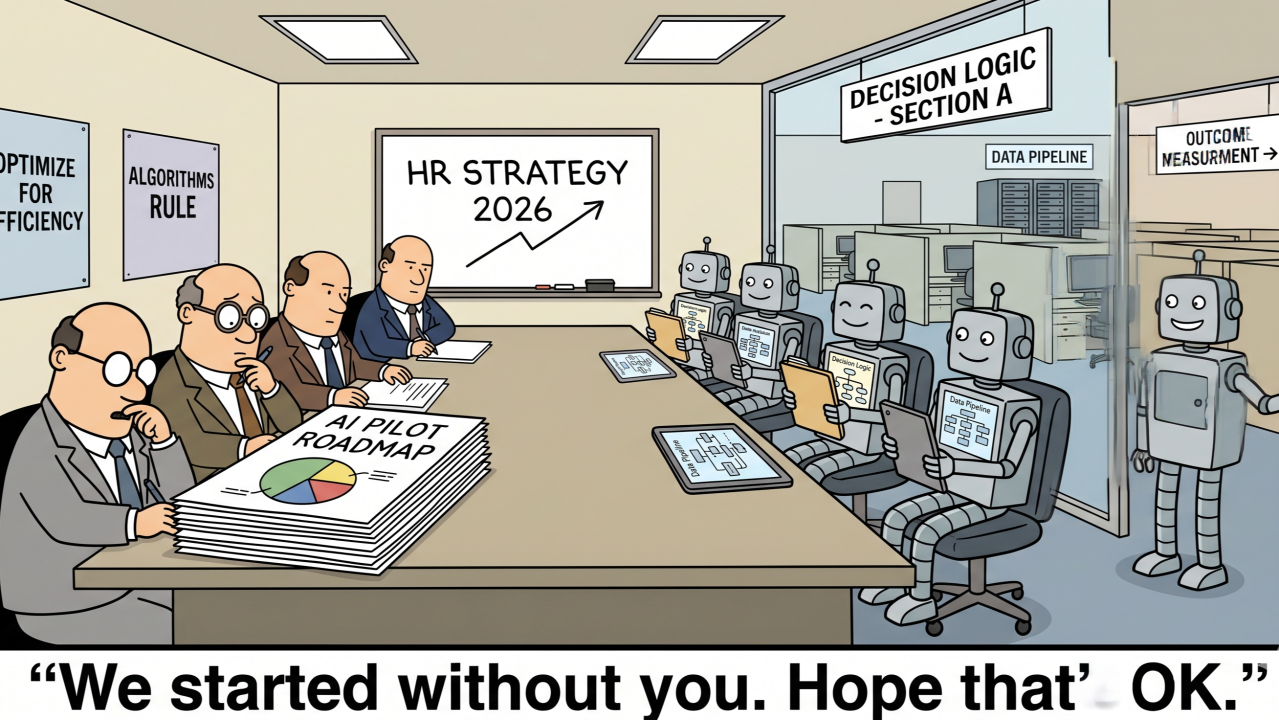
HR's AI operating system is being built. HR isn't building it.
The Headline Insight
In Q3 2025, KPMG published its AI Quarterly Pulse Survey with a breakdown of agent deployment by business function. Technology: 95%. Operations: 89%. Risk management: 66%. Human Resources: 2%. That number - two percent - should end every conversation about whether HR is ready for agentic AI. It is not. And the companies building this future are no longer waiting for HR to catch up.
The Argument
The shift that happened in March
In a single month, three things occurred that would normally take years to converge. Microsoft restructured its entire HR function - all 220,000 employees worth of it - around AI. Amy Coleman, the company's Chief People Officer, sent a memo that read less like an org announcement and more like a strategic pivot: People Analytics was merged into Employee Experience under Nathalie D'Hers. A new Workforce Acceleration team was created under Justin Thenutai, chartered explicitly around human-agent collaboration. Engineering HR was consolidated under a single leader. Three veteran HR executives retired, including Dawn Klinghoffer, who built Microsoft's People Analytics function over two decades.
In the same month, SAP shipped agentic AI capabilities across its SuccessFactors suite - not as a roadmap promise but as a production release, with named agents for performance, payroll, career development, and talent intelligence. Oracle launched eight new "Fusion Agentic Applications" for HCM, framing the move as a shift from assistance to execution. And Gartner published research showing that adapting the HR operating model to AI has the highest predicted impact on productivity - 29% - outpacing AI skills training, AI knowledge sharing, and even AI tool adoption itself.
These are not trend signals. They are structural facts. The HR operating system is being rebuilt around agents, and it is being rebuilt by technology companies and consulting firms, not by HR leaders.
Why this should worry every CHRO reading this
Here is the uncomfortable pattern. When KPMG says 54% of organizations have deployed AI agents as of early 2026, and then you look at which functions are actually using them, HR barely registers. Technology departments got there first because they sit closest to the tooling. Operations followed because their workflows are structured and measurable. HR - the function that owns the workforce, that is supposed to plan for skill shifts, that talks constantly about being "a strategic partner" - arrived last.
The standard explanation is that HR deals with sensitive decisions and needs to be careful. That explanation is correct and also irrelevant. The EU AI Act, fully enforceable by August 2026, already classifies most HR AI applications - recruiting, performance, workforce management - as high-risk. The legal and governance framework exists. What doesn't exist, in most HR functions, is the structural capacity to operate AI agents at all. The COE/HRBP/Shared Services model was designed for a world of manual processes and ticket-based service delivery. Plugging an autonomous agent into that architecture is like installing a jet engine on a bicycle. The engine works. The bicycle doesn't survive.
Gartner's finding is the precise articulation of this problem: the highest productivity gains come not from better AI tools but from redesigning how the function operates. The 29% isn't about software. It's about architecture.
The People Analytics angle - and why Microsoft's move matters more than it looks
When Amy Coleman merged People Analytics into Employee Experience, some in the PA community read it as a downgrade. I read it as the opposite.
For years, People Analytics has operated as an internal consultancy - a team that produces insights and hands them to someone else to act on. The separation between "generating the insight" and "doing something with it" is the single biggest reason most PA teams feel undervalued. They know the answer. They watch someone else ignore it or dilute it into a committee process.
Microsoft's restructuring collapses that gap. By putting analytics inside the function that owns the employee experience, the insight and the action sit in the same team. Coleman's memo explicitly called this out: the goal is "faster learning and stronger insight-to-action loops." That language is operational, not decorative.
Now extend this logic to agentic AI. An AI agent that screens candidates, recommends internal moves, flags attrition risk, or personalizes onboarding is only as good as the data pipeline it sits on and the decision logic that governs it. Who builds that pipeline? Who calibrates that logic? Who audits whether the agent's outputs connect to outcomes the business actually cares about?
Not the HRBP. Not the COE. The analytics function. People Analytics is the only part of HR that already works at this layer - connecting data sources, translating business questions into measurable signals, validating whether interventions produce results. In an agentic HR architecture, PA doesn't produce reports. It becomes the operating logic.
The contrarian take: stop buying tools, start redesigning the function
Most of the advice CHROs are receiving right now sounds like this: "Start with a pilot. Pick a low-risk workflow. Automate interview scheduling. Scale from there." This advice is technically correct and strategically dangerous.
If you bolt agentic AI onto the existing HR model - the same siloed COEs, the same fragmented HRBP roles, the same ticket-based shared services - you will get faster execution of the same broken processes. You'll schedule interviews 40% faster for a hiring pipeline that still doesn't predict performance. You'll automate onboarding checklists for an experience that still fails to retain people past 18 months. In French we have a phrase for this: plus ça change, plus c'est la même chose. Except now it costs more.
The companies that will win this transition are the ones treating agentic AI as a forcing function to redesign the HR architecture itself. Microsoft did not add AI tools to its existing HR org. It blew up the org and rebuilt it around new capabilities: analytics embedded in experience, workforce acceleration as a dedicated function, engineering HR consolidated for speed.
That is a structural decision, not a technology decision. And it is the decision most CHROs have not yet made.
What This Means in Practice
If you lead an HR function of any size, three things need to happen in the next 90 days - not in 2027, not after the next budget cycle.
First, audit your HR architecture against the agentic future. Map your current operating model - COEs, HRBPs, shared services, analytics - and ask one question for each box: can an AI agent operate inside this structure, or does the structure need to change for agents to work? If the answer is "change," you are looking at a redesign, not a deployment.
Second, stop treating People Analytics as a reporting function and start treating it as infrastructure. If your PA team still spends most of its time building dashboards and answering ad hoc questions from HRBPs, it is not positioned to become the orchestration layer for AI agents. Reorient PA toward decision architecture: which workforce decisions matter most to the business, what data governs those decisions, and what logic should an agent follow when making or recommending them?
Third, call your HCM vendor this month and ask one specific question: what tasks can your AI agents execute autonomously, and what governance model do they require? If the answer is vague - "AI-powered insights" or "intelligent recommendations" - your vendor is selling you a copilot dressed as an agent. You need to know the difference, because your operating model depends on it.
One Thing to Watch
Microsoft's new Workforce Acceleration team, led by VP Justin Thenutai. Its charter - skilling, redeployment, and human-agent collaboration - is the first time a Fortune 10 company has created a dedicated HR function for managing the intersection of human and AI work. If this team produces measurable outcomes in the next 12 months, expect every large enterprise to replicate it. If it doesn't, the conversation shifts from "how to restructure" to "why restructuring failed." Either way, this is the team to follow.
The Closing Provocation
Here is the question I'd like every CHRO and Head of People Analytics reading this to answer honestly: if you removed your entire People Analytics team tomorrow, which AI agents in your HR function would stop working? If the answer is "none, because we don't have any" - you've just measured the gap between where you are and where Microsoft moved in March.
Sources & References
- KPMG Q3 2025 AI Quarterly Pulse Survey - agent deployment by function (Technology: 95%, Operations: 89%, HR: 2%)
- Microsoft HR restructuring memo, Amy Coleman, March 2026 - reported by CNBC, HR Brew, Business Insider, HR Grapevine
- SAP SuccessFactors 1H 2026 Release - agentic AI capabilities across Joule agents
- Oracle Fusion Agentic Applications for HCM - eight new applications, April 2026
- Gartner 2024 Productivity Impact of AI Survey - operating model adaptation yields highest productivity impact at 29%
- Gartner 2026 CHRO Priorities - based on 426 CHROs across 23 industries
- Gartner, "The Future of AI in HR: Reinventing the Operating Model," Hanne Nieberg, March 2026
- KPMG Q1 2026 AI Pulse - 54% of organizations actively deploying AI agents; 63% require human validation
- EU AI Act - full enforcement August 2, 2026; HR AI classified as high-risk
- Asanify Agentic AI HR Workflows digest, April 14, 2026 - Microsoft restructure analysis and SHRM 2026 AI report
Originally published in The Agentic HR Shift on LinkedIn.