Is AI the answer to HR's data literacy challenge ? Or the reason it will make this gap bigger?
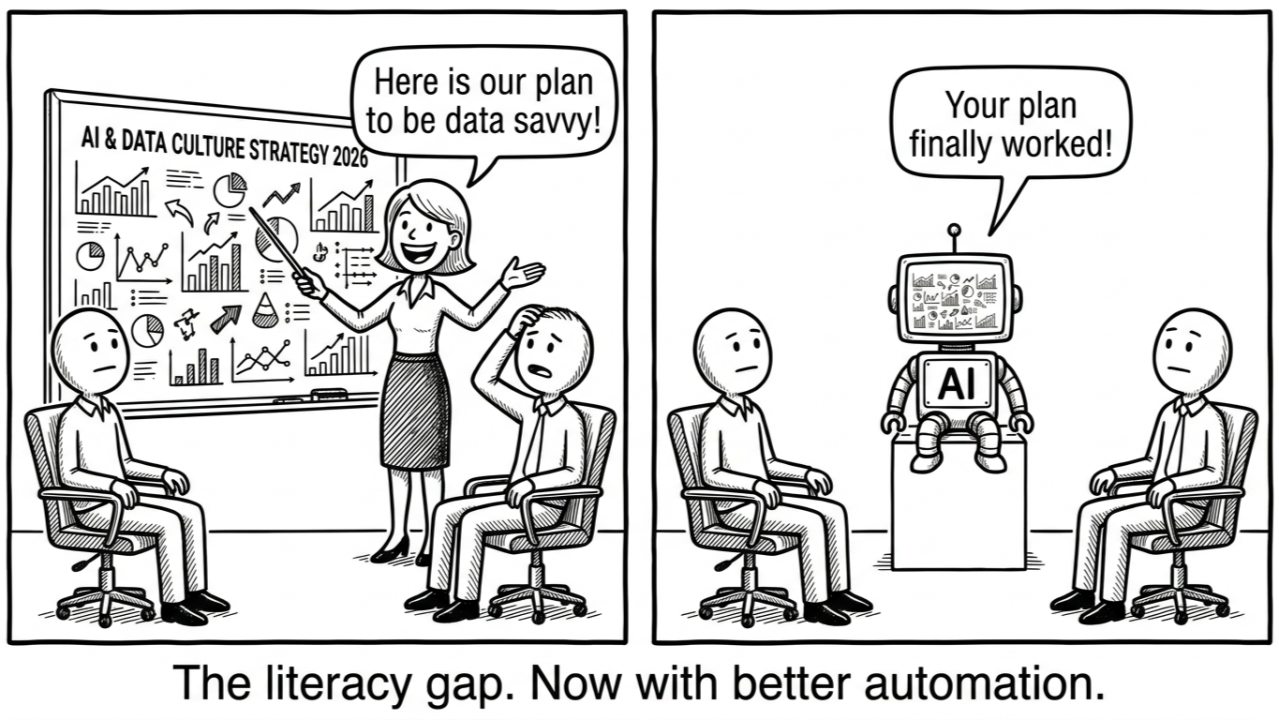
Twelve years. And we're still here.
I've spent the last twelve years inside HR functions - large, global, well-funded ones. Companies with strategy decks, data roadmaps, HR transformation programmes, and enough consultants cycling through to wallpaper a boardroom.
And here is what I observed: data savviness in HR barely improved.
Not because the ambition wasn't there. Not because the tools and technologies weren't improving. But because changing how people think about evidence - how they instinctively reach for a number or a data point before forming an opinion, how they challenge a gut feeling with a dataset - is hard. It is not a technology problem. It is a culture problem. And culture does not change because you built a dashboard.
I watched organisations roll out many People Analytics products to HR communities that had never been trained to ask a question properly. I watched "data literacy programmes" launch in Q1 and quietly die by Q3 when the next priority landed. I watched People Analytics teams produce insights that no one used outside a slide deck, to make a change.
The intent was genuine. The execution was insufficient. And after twelve years, the gap between HR functions that truly reason with data and those that merely report numbers remained - stubbornly, frustratingly - wide.
Then AI arrived. And widened it further.
Here is the uncomfortable truth that most of the market is dancing around: AI does not solve the data literacy problem in HR. It accelerates it into a crisis.
The companies that were already investing seriously in data culture - building the habit of evidence-based reasoning, upskilling their HR practitioners to interpret results, training managers to challenge the stories data can tell - are now compounding that advantage with AI. Every AI tool they adopt lands in a team that knows what to do with it.
The companies that skipped that work, that kept running on gut feel dressed up as "experience", that treated data as a reporting obligation rather than a thinking tool - those companies are now handing judgment to systems they cannot interrogate. They are getting outputs without understanding the inputs. They are automating the wrong things faster.
The numbers make this uncomfortable to ignore. Insight222's 2024 People Analytics Trends Report - still the most cited benchmark in the field - found that only 58% of companies report having a data-driven culture for people data, and just 51% report that HR practitioners are actively developing their data literacy skills. Their 2025/26 report, "Navigating AI and People Analytics: From Ambition to Action", based on input from over 370 organisations globally, makes clear that the gap between ambition and execution is not narrowing - it is the defining challenge of the function right now. After a decade of "HR transformation" and "data-driven HR" becoming the industry's favourite phrase, roughly half of organisations still cannot honestly say they have built a culture around it.
And from a 2026 DataCamp/YouGov survey of 500+ enterprise leaders: 60% acknowledge a data skills gap, despite 88% agreeing that data literacy is essential for day-to-day work. The knowing-doing gap is not new. But with AI in the equation, it is no longer just uncomfortable. It is a strategic liability.
Two camps. One winner.
I hear two versions of the future when I talk to HR leaders about AI.
The pessimists say: "AI will replace HR jobs." I disagree with the framing. AI will not replace HR professionals. But HR professionals who master AI - who understand how to frame a question, interpret an output, sense-check a model, and translate a result into a business recommendation - will replace those who don't. This is not a threat. It is a skill differential. And skill differentials, over time, become organisational differentials.
The optimists say: "AI is not that smart. It hallucinates, can't understand context, semantics, nuance. Human judgment will always matter." They are right - but they are using this as a reason to delay rather than a reason to prepare. Yes, AI struggles with ambiguity. It still needs humans who can reason, advise, challenge, and contextualise. But here is the uncomfortable corollary: if your HR team cannot do those things without AI, they will not be able to do them with it either. AI amplifies existing capability. It does not create it from scratch.
The gap is not human vs. machine. The gap is between the HR professionals who can think with data - and use AI as a force multiplier - and those who cannot. That gap is widening every quarter. Not because AI is so powerful, but because some organisations are compounding their advantage and others are standing still.
This is not inevitable. But it requires a decision.
Tools and technologies do not teach critical thinking. They do not build the habit of questioning an assumption. They do not instil the discipline of connecting a workforce metric to a business outcome. That work belongs to leaders and practionners. And it requires deliberate investment - in curriculum, in coaching, in upskilling/reskilling, in the cultural expectation that data fluency is a professional standard, not an optional extra.
The organisations that will win the next phase of HR - not just in efficiency, but in strategic influence - are the ones that are making that investment now. Not in another dashboard. Not in another platform. In their people's ability to reason and think.
A word on what actually works.
I joined Insight222 because I believe that closing this gap is the most important work in People Analytics right now. For nearly a decade, Insight222 has worked with hundreds of enterprise organisations to do exactly this - help HR leaders and their teams build the data and analytics capabilities that turn HR into a genuine business function.
Not through generic training. Through the kind of advisory, research-backed, practitioner-led work that actually changes behaviour. The kind that sticks over time.
If you are a CHRO, a Head of People Analytics, or an HR leader who recognises this challenge in your organisation - and who does not want to be on the wrong side of this gap and remain relevant - I would genuinely welcome a conversation. Drop me a DM.
The challenge I want to leave you with.
Think about the last three people decisions your organisation made. A reorganisation. A hiring freeze. A leadership development investment.
How much of the reasoning behind those decisions was grounded in evidence? How many people in the room could challenge the data - not just receive it? And if an AI model had generated a recommendation, how many of them could interrogate its logic?
If the honest answer to any of those questions gives you pause, then the conversation about data savviness in your HR function is not a future agenda item.
It is already overdue.
I am Senior Director at Insight222, the leading People Analytics advisory firm. We help organisations build the data and analytics capabilities that connect HR to business outcomes. Follow me for weekly content on People Analytics, AI in HR, and what it actually takes to make evidence-based HR a reality.
#PeopleAnalytics #HRStrategy #DataLiteracy #AIinHR #HRTransformation #DataCulture #Insight222
📚 Sources referenced in this article:
- Insight222 People Analytics Trends Report 2024 - via myHRfuture.com
- Insight222 People Analytics Trends Report 2025/26 - "Navigating AI and People Analytics: From Ambition to Action" - insight222.com
- DataCamp / YouGov - 2026 State of Data & AI Literacy Report - datacamp.com
Originally published in The Agentic HR Shift on LinkedIn.