Data as a company intangible asset - Your most valuable asset is worth zero on paper
𝑇ℎ𝑒 𝐿𝐿𝑀 𝑡𝑜𝑘𝑒𝑛 𝑖𝑠 𝑎 𝑐𝑜𝑠𝑡. 𝑌𝑜𝑢𝑟 𝑜𝑣𝑒𝑟𝑎𝑙𝑙 𝑑𝑎𝑡𝑎 𝑖𝑠 𝑡ℎ𝑒 𝑟𝑒𝑎𝑙 𝑎𝑠𝑠𝑒𝑡.
In March 2023, GPT-4 launched at $30 per million input tokens. In April 2026, a model that beats it on every benchmark that existed back then costs about $0.10. That is a 99% collapse in three years, and it is still going. Andreessen Horowitz gave the trend a name, LLMflation: for equivalent performance, inference cost falls roughly tenfold every year. DeepSeek entered the market undercutting incumbents by around 90% and nobody blinked, because by then a 90% cut was just Tuesday.
Here is what that number actually tells you. The model is not your moat. It is a cost line, and the cost line is racing to zero. Whatever frontier capability you are paying a premium for today will be a commodity your competitor buys at a vending-machine price within eighteen months. You cannot build an advantage on an input that everyone can rent for a few euros and that gets cheaper every quarter.
So stop watching the model. Watch the thing the model runs on.
The asset hiding in plain sight
Your competitors can buy the same model you can. What they cannot buy is your data: fifteen years of how your customers actually behave, which of your people stay and which leave and why, what your operations look like at 2am on a bad day. That asset is not for rent. It is the one input in your AI stack that is genuinely, structurally yours.
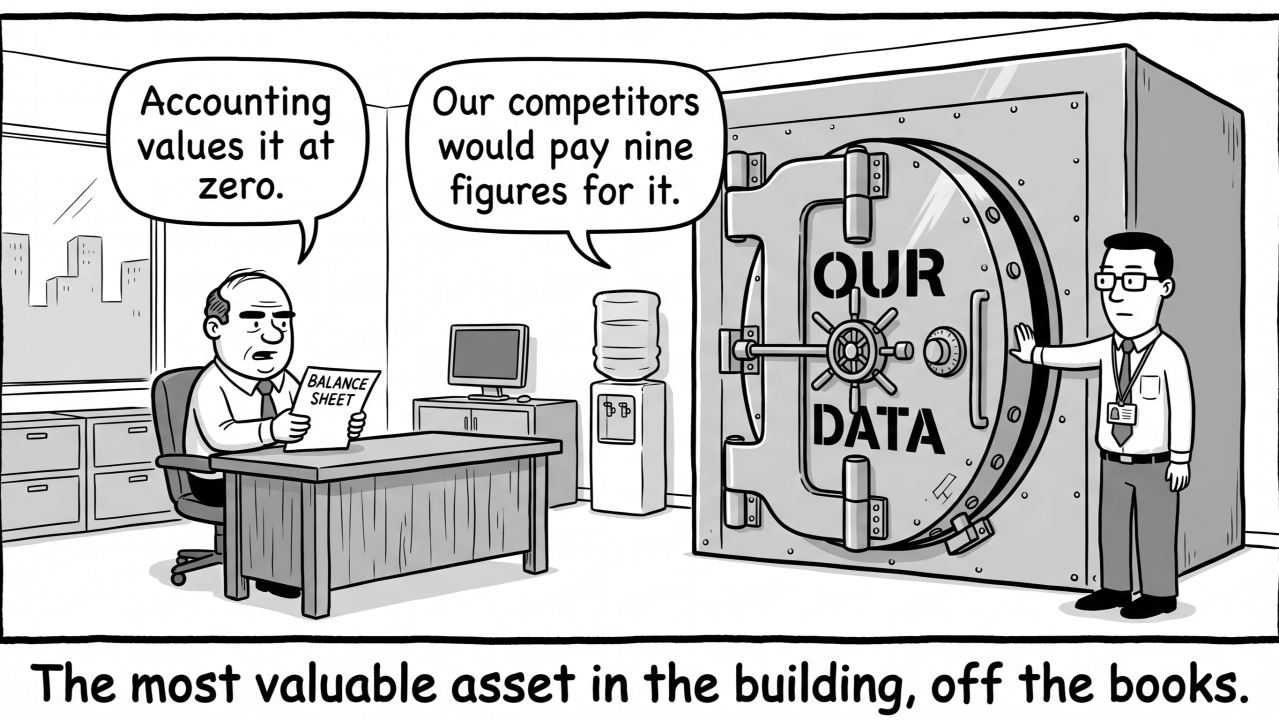
And on your balance sheet, it is worth exactly nothing.
This is not an accident or an oversight. Under both GAAP and IFRS, internally generated data is expensed as it is created and never capitalised. It only appears as an asset if you bought it from someone else or acquired it through M&A. Build the most valuable customer dataset in your industry yourself, and the accounting rules assign it a book value of zero. A Columbia Business School paper put it plainly: the data behind some of the most valuable firms on earth is treated as though it has no value at all.
The scale of the blind spot is easy to miss. In 1975, tangible assets made up around 83% of the average S&P 500 company's value. By 2015 that had inverted: intangibles, data, intellectual property, brand, accounted for over 80%, and the figure has only climbed since. The majority of what your company is worth does not appear on the document that is supposed to say what your company is worth. We are running modern enterprises on a measurement system designed for factories and inventory.
What it would take to put a price on it
The concepts already exist. Doug Laney, who coined the term "infonomics" at Gartner, laid out three financial approaches, each built around a single question.
Cost Value asks: what would it cost us to replace this data if we lost it tomorrow? This is the insurance lens. It is the easiest to defend to an auditor because it anchors on real spend, and it is also the one that most undersells the asset, because replacement cost says nothing about what the data earns.
Market Value asks: what could we sell or license this data for? Useful when a market exists, close to useless when it does not, and most of the data that gives you an edge is precisely the data no one else can legally buy.
Economic Value asks: what does this data contribute to the bottom line? What decisions does it improve, what revenue does it protect, what risk does it remove? This is the hard one. It is also the only one worth your time.
My position is that a CFO should treat Cost and Market value as footnotes and build the case on Economic Value. The reason is simple: the other two measure what the data is; Economic Value measures what the data does. A dataset that sits in a warehouse improving no decision is worth its storage cost and nothing more, regardless of how big it is. A smaller dataset that sharpens a pricing decision worth millions is the actual asset. This is the same discipline good People Analytics already applies to its own work. We do not value a survey by its response rate. We value it by the decision it changes. Data is no different. The volume is not the asset. The decision it improves is the asset.
The gap is a choice, not a law
If this sounds too theoretical to act on, consider that another economy already moved. China updated its accounting guidance to let companies record internal-use data resources as a balance-sheet line item. Western standards still do not. You can argue about whether that is wise, and the auditors who worry about subjectivity and "noise" in financial statements have a real point. But it kills the excuse that valuing data is impossible. It is not impossible. It is unfamiliar, and those are very different problems.
You do not need to wait for the standards bodies to catch up before you act internally. Laney's own observation, drawn from looking at Wall Street, was that companies which treated information as an asset tended to carry market-to-book ratios two to three times higher than their peers. The market is already pricing the data you are not. The only party in the dark is often the company that owns it.
What to do before the auditors arrive
Build a shadow data P&L. Pick your three or four most-used datasets and run them through the Economic Value question, in writing: which business decisions does each one feed, and what is the cost of getting those decisions wrong. You will not get a number an auditor would sign. You will get something more useful in the meantime: a ranking of which data assets actually earn their keep and which are expensive clutter. That alone reorders an analytics budget.
Then connect it to where the spend is going. Every agentic AI decision your organisation is about to automate will run on this data. If the data underneath an agent is unvalued and ungoverned, you are not deploying an asset, you are scaling an unmeasured liability at machine speed. Pricing your data and governing your data turn out to be the same project, and that project is the moat. The model is rented. The data is owned. Only one of those is worth defending.
The next time someone in your leadership team gets excited about which model to buy, ask the better question. Not "which model," but "what is our data worth, and who else can get it?" If the honest answer to the second half is "anyone, eventually," you were never talking about a moat. If the answer is "no one, ever," you are sitting on the only competitive edge in the building that does not depreciate to zero. Has anyone bothered to price it?
📚 Sources:
- a16z, "Welcome to LLMflation" (10x annual inference cost decline)
- AI Magicx / Epoch AI, LLM pricing 2026 (GPT-4 $30 → ~$0.10 per M tokens; ~99% drop)
- Columbia Business School, Veldkamp, "Valuing Data as an Asset" (GAAP zero book value)
- Doug Laney, "Infonomics" (Gartner): Cost, Market, and Economic Value of Information
- Ocean Tomo / IRI, intangible share of S&P 500 value (17% in 1975 → 80%+ today)
- ICAEW, "Data - A New Emerging Type of Intangible" (China internal-use data assets on balance sheet)
- CFA Institute, "The Intangible Valuation Renaissance" (GAAP vs IFRS treatment of intangibles)
Originally published in The Agentic HR Shift on LinkedIn.